Effects of high turbidity seawater on removal of boron and transparent exopolymer particles by chemical oxo-precipitation
Justin Chun-Te Lin, Chin-Yi Wu, Yung-Lun Chu, Winn-Jung Huang
文献索引:10.1016/j.jtice.2018.02.012
全文:HTML全文
摘要
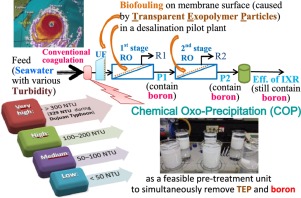
Boron and transparent exopolymer particles (TEP) in seawater presented two hurdles in desalination as the former can pass through reverse osmosis easily and the latter can induce membrane biofouling. Chemical oxo-precipitation (COP) was evaluated and its feasibility of boron removal in seawater during normal conditions and high turbidity caused by a typhoon. Various COP conditions in seawater were conducted by a series of jar tests for seawater sampled from an intake of desalination pilot plant. Both boron concentrations in upper liquids using FeCl3 or BaCl2 as coagulant were found increased linearly with increasing oxidant amounts after addition of H2O2 as an oxidant. However, colloidal TEP and particle analysis by nanoparticle tracking analysis provided more insights of the aggregated sizes. Effects of three COP operational parameters on the removal of boron and TEP as well as turbidity were investigated and optimized by a response surface methodology via Box–Behnken design. These results provide a good reference in design feasible pre-treatment dealing with the two current hurdles of seawater RO systems.