Modularized peptides modified HBc virus-like particles for encapsulation and tumor-targeted delivery of doxorubicin
Wenjun Shan, Deliang Zhang, Yunlong Wu, Xiaolin Lv, Bin Hu, Xi Zhou, Shefang Ye, Shengli Bi, Lei Ren, Xianzhong Zhang
文献索引:10.1016/j.nano.2017.12.002
全文:HTML全文
摘要
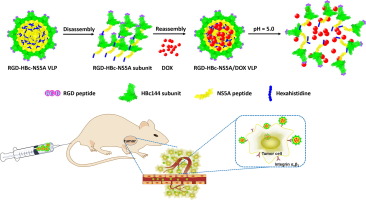
Virus-mimicking particles have made great contribution to the development of nanomedicine. Herein, several modularized peptides (lipophilic NS5A peptide, 6xHis tag, and tumor-targeting peptide RGD) were genetically inserted into the C-terminus and the major immunodominant loop region (MIR) of hepatitis B core protein (HBc), respectively. This study demonstrated that the recombinant HBc-based VLPs could participate in self-assembly of monodisperse nanoparticles (33.6 ± 3.5 nm) with well-defined morphology, and DOX can be packaged into VLNPs without any chemical modification. Moreover, the HBc-based VLPs could specifically target to cancer cells via the interaction with overexpressed integrin αvβ3. The treatment with DOX-loaded HBc-based VLPs showed a significant inhibition of tumor growth (90.7% TGI) and less cardiotoxicity in B16F10 tumor-bearing mice models than that with the free DOX. Importantly, the results may offer an easy way to give a variety of ideal functional modulations for VLPs, thereby extending its potential biomedicine applications.