A Low-Temperature Thin-Film Encapsulation for Enhanced Stability of a Highly Efficient Perovskite Solar Cell
Young Il Lee, Nam Joong Jeon, Bong Jun Kim, Hyunjeong Shim, Tae-Youl Yang, Sang Il Seok, Jangwon Seo, Sung Gap Im
文献索引:10.1002/aenm.201701928
全文:HTML全文
摘要
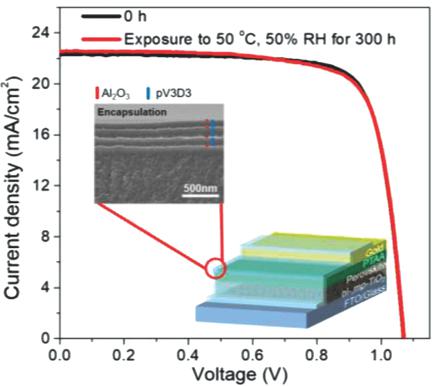
The stability of a perovskite solar cell (PSC) is enhanced significantly by applying a customized thin-film encapsulation (TFE). The TFE is composed of a multilayer stack of organic/inorganic layers deposited by initiated chemical vapor deposition and atomic layer deposition, respectively, whose water vapor transmission rate is on the order of 10−4 g m−2 d−1 at an accelerated condition of 38 °C and 90% relative humidity (RH). The TFE is optimized, taking into consideration various aspects of thermosensitive PSCs. Lowering the process temperature is one of the most effective methods for minimizing the thermal damage to the PSC during the monolithic integration of the TFE onto PSC. The direct deposition of TFE onto a PSC causes less than 0.3% degradation (from 18.5% to 18.2%) in the power conversion efficiency, while the long-term stability is substantially improved; the PSC retains 97% of its original efficiency after a 300 h exposure to an accelerated condition of 50 °C and 50% RH, confirming the enhanced stability of the PSC against moisture. This is the first demonstration of a TFE applied directly onto PSCs in a damage-free manner, which will be a powerful tool for the development of highly stable PSCs with high efficiency. The thin-film encapsulation (TFE) via initiated chemical deposition and low-temperature atomic layer deposition effectively enhances the stability of a high-efficient perovskite solar cell (PSC). The TFE is directly deposited onto the PSC without degradation, and the encapsulated PSC retains 97% of its original efficiency after a 300 h exposure to an accelerated condition of 50 °C and 50% relative humidity.