Key odorants or key associations? Insights into elemental and configural odour processing
Sébastien Romagny, Gérard Coureaud, Thierry Thomas-Danguin
文献索引:10.1002/ffj.3429
全文:HTML全文
摘要
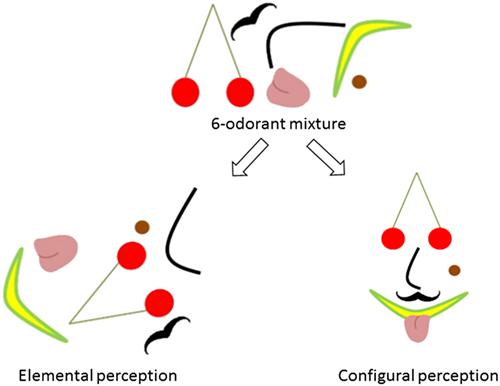
Determining whether odorants can be perceived in an odour mixture or whether the mixture smells different from its components remains challenging. Even in highly complex mixtures, the odour qualities of some elements can be perceived; thus, their identity is conserved within the mixture. Such elements are considered key components and support the elemental perception of the mixture. The concept of key components is also related to elements that do not necessarily carry the odour quality of the mixture but that induce a change in overall mixture perception when they are omitted. In this case, mixture perception often relies on configural processing. To disentangle these multiple aspects of these so-called key odorants, we sought to study the perceptual role of odorants included in mixtures that are elementally or configurally perceived. Two mixtures, known to be processed configurally and elementally and containing the same 6 odorants in different proportions, were used as references in 4 similarity-rating experiments. A total of 246 participants evaluated the similarity between the references and single odorants or mixtures of 2 to 6 odorants. This procedure aimed to evaluate whether single odorants or combinations of odorants can evoke the odour quality of the mixtures. Overall, the results highlighted that elemental perception depended primarily on the odour quality and concentration ratio of many of the mixed odorants, whereas configural perception depended on specific associations of odorants in strict concentration ratios. These results led us to reconsider the impact of key elements in odour mixtures within the framework of a perceptual model stating that elemental perception of odour mixtures relies on perception of key odorants, the perceptual features of which are still perceived within the mixture, whereas configural perception relies on key associations of odorants that lose their individual identity when mixed at specific concentration ratios. Elemental perception of odour mixtures depends on odour quality and concentration ratio of many of the mixed odorants, whereas configural perception depends on specific associations of odorants in strict concentration ratios. Therefore, a new perspective in flavour analysis, relying on the identification of key elements in complex mixtures should consider both key odorants, the perceptual features of which are still perceived within the mixture, and key associations of odorants that lose their individual identity when mixed at specific concentration ratios.