Ipragliflozin L-Proline
Modify Date: 2025-08-25 08:16:59
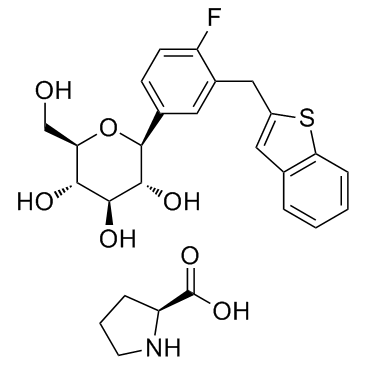
Ipragliflozin L-Proline structure
|
Common Name | Ipragliflozin L-Proline | ||
|---|---|---|---|---|
| CAS Number | 951382-34-6 | Molecular Weight | 519.58200 | |
| Density | N/A | Boiling Point | N/A | |
| Molecular Formula | C26H30FNO7S | Melting Point | N/A | |
| MSDS | N/A | Flash Point | N/A | |
Use of Ipragliflozin L-ProlineIpragliflozin (L-Proline) is a highly potent and selective SGLT2 inhibitor with an IC50 of 2.8 nM; little and NO potency for SGLT1/3/4/5/6. |
| Name | (2S,3R,4R,5S,6R)-2-[3-(1-benzothiophen-2-ylmethyl)-4-fluorophenyl]-6-(hydroxymethyl)oxane-3,4,5-triol,(2S)-pyrrolidine-2-carboxylic acid |
|---|---|
| Synonym | More Synonyms |
| Description | Ipragliflozin (L-Proline) is a highly potent and selective SGLT2 inhibitor with an IC50 of 2.8 nM; little and NO potency for SGLT1/3/4/5/6. |
|---|---|
| Related Catalog | |
| Target |
IC50 value: 2.8 nM (SGLT2)[1][2]. |
| In Vitro | Ipragliflozin (L-Proline) potently and selectively inhibits human, rat, and mouse SGLT2 at nanomolar ranges and exhibits stability against intestinal glucosidases[3]. |
| In Vivo | Ipragliflozin (L-Proline) shows good pharmacokinetic properties following oral dosing, and dose-dependently increases urinary glucose excretion, which lasts for over 12 h in normal mice [3]. Oral administration of ipragliflozin increases urinary glucose excretion in a dose-dependent manner, an effect which is significant at doses of 0.3 mg/kg or higher and lasts over 12 h[4]. Single administration of ipragliflozin dose-dependently increases urinary glucose excretion, reduces blood glucose and plasma insulin levels, and improves glucose intolerance [5]. |
| References |
| Molecular Formula | C26H30FNO7S |
|---|---|
| Molecular Weight | 519.58200 |
| Exact Mass | 519.17300 |
| PSA | 167.72000 |
| LogP | 2.29790 |
| InChIKey | TUVGWWULBZIUBS-FVYIYGEMSA-N |
| SMILES | O=C(O)C1CCCN1.OCC1OC(c2ccc(F)c(Cc3cc4ccccc4s3)c2)C(O)C(O)C1O |
| Storage condition | 2-8℃ |
| ASP-1941 |
| Ipragliflozin L-proline |
| UNII-M6N3GK48A4 |
| Ipragliflozin (L-Proline) |
The content on this webpage is sourced from various professional data sources. If you have any questions or concerns regarding the content, please feel free to contact service1@chemsrc.com.
- Shanghai Nianxing Industrial Co., Ltd
- China
- Product Name: Ipragliflozin L-Proline
- Price: Check
- Purity: 90.0%
- Delivery: 10 Day
- Contact: Yang
- Email: sales@echemcloud.com
- Shanghai Jizhi Biochemical Technology Co., Ltd
- China
- Product Name: Ipragliflozin L-Proline
- Price: ¥1976.0/1g ¥786.0/250mg
- Purity: 95.0%
- Delivery: 2 Day
- Contact: Liu jia


- Email: 2130147988@qq.com
- DC Chemicals Limited
- China
- Product Name: Ipragliflozin (L-Proline)
- Price: $350.0/100mg $550.0/250mg $1100.0/1g
- Purity: 98.0%
- Delivery: 3 Day
- Contact: Tony Cao
- Email: sales@dcchemicals.com
- ShangHai DC Chemicals Co.,Ltd
- China
- Product Name: Ipragliflozin L-Proline
- Price: ¥Inquiry/1g
- Purity: 98.9%
- Delivery: 1 Day
- Contact: Tony Lai
- Email: order@dcchemicals.com
- Shanghai Amole Biotechnology Co., Ltd.
- China
- Product Name: Ipragliflozin L-Proline
- Price: ¥Inquiry/100mg ¥Inquiry/10mg ¥Inquiry/1g ¥Inquiry/250mg
- Purity: 98.0%
- Delivery: Inquiry
- Contact: Xiyao Wang
- Email: 3623107365@qq.com
- Henan Tianfu Chemical Co., Ltd.
- China
- Product Name: L-Proline compd. with (1S)-1,5-anhydro-1-C-[3-(benzo[b]thien-2-ylmethyl)-4-fluorophenyl]-D-glucitol
- Price: $Inquiry/1kg $Inquiry/25kg $Inquiry/1000kg $Inquiry/10ton
- Purity: 99.0%
- Delivery: Inquiry
- Contact: Anson
- Email: info@tianfuchem.com
Get all suppliers and price by the below link:
Ipragliflozin L-Proline suppliers
Price: ¥1100/5 mg
Reference only. check more Ipragliflozin L-Proline price