STF 118804
Modify Date: 2025-08-25 16:46:14
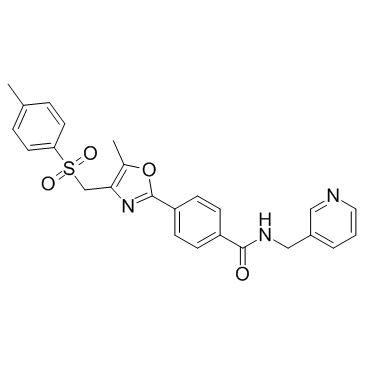
STF 118804 structure
|
Common Name | STF 118804 | ||
|---|---|---|---|---|
| CAS Number | 894187-61-2 | Molecular Weight | 461.533 | |
| Density | 1.3±0.1 g/cm3 | Boiling Point | N/A | |
| Molecular Formula | C25H23N3O4S | Melting Point | N/A | |
| MSDS | USA | Flash Point | N/A | |
Use of STF 118804STF-118804 is a highly specific NAMPT inhibitor; reduces the viability of most B-ALL cell lines with IC50 <10 nM.IC50 value:Target: NAMPT inhibitorin vitro: improves survival in an orthotopic xenotransplant model of high-risk acute lymphoblastic leukemia, and targets leukemia stem cells. STF-118804 displays distinctive cytotoxicity by inducing apoptosis without causing a phase-specific cell cycle arrest. Over-expression of NAMPT rendered 293T cells more resistant to STF-118804 resulting in a higher IC50 (106 nM, 95% CI 74–151 nM) compared to control cells (17 nM, 95% CI 13–23 nM), further confirming that NAMPT protein levels dictate sensitivity to STF-118804 [1].in vivo: STF-118804 displayed high efficacy in a xenograft model of ALL. Mice treated with STF-118804 over a 20-day period survived an average of 34 days longer than vehicle-treated animals. During treatment, bioimaging showed regression of tumor followed by suppression of disease. STF-118804 was tolerated in the efficacious dose range, and the absence of adverse physical or pathological effects indicated that toxicity was not limiting in a 20-day study of mock transplanted mice [1]. |
| Name | 4-[5-methyl-4-[(4-methylphenyl)sulfonylmethyl]-1,3-oxazol-2-yl]-N-(pyridin-3-ylmethyl)benzamide |
|---|---|
| Synonym | More Synonyms |
| Description | STF-118804 is a highly specific NAMPT inhibitor; reduces the viability of most B-ALL cell lines with IC50 <10 nM.IC50 value:Target: NAMPT inhibitorin vitro: improves survival in an orthotopic xenotransplant model of high-risk acute lymphoblastic leukemia, and targets leukemia stem cells. STF-118804 displays distinctive cytotoxicity by inducing apoptosis without causing a phase-specific cell cycle arrest. Over-expression of NAMPT rendered 293T cells more resistant to STF-118804 resulting in a higher IC50 (106 nM, 95% CI 74–151 nM) compared to control cells (17 nM, 95% CI 13–23 nM), further confirming that NAMPT protein levels dictate sensitivity to STF-118804 [1].in vivo: STF-118804 displayed high efficacy in a xenograft model of ALL. Mice treated with STF-118804 over a 20-day period survived an average of 34 days longer than vehicle-treated animals. During treatment, bioimaging showed regression of tumor followed by suppression of disease. STF-118804 was tolerated in the efficacious dose range, and the absence of adverse physical or pathological effects indicated that toxicity was not limiting in a 20-day study of mock transplanted mice [1]. |
|---|---|
| Related Catalog | |
| References |
| Density | 1.3±0.1 g/cm3 |
|---|---|
| Molecular Formula | C25H23N3O4S |
| Molecular Weight | 461.533 |
| Exact Mass | 461.140930 |
| PSA | 110.54000 |
| LogP | 3.08 |
| Index of Refraction | 1.609 |
| InChIKey | DLFCEZOMHBPDGI-UHFFFAOYSA-N |
| SMILES | Cc1ccc(S(=O)(=O)Cc2nc(-c3ccc(C(=O)NCc4cccnc4)cc3)oc2C)cc1 |
| Storage condition | -20℃ |
| RIDADR | NONH for all modes of transport |
|---|
| 4-(5-Methyl-4-{[(4-methylphenyl)sulfonyl]methyl}-1,3-oxazol-2-yl)-N-(3-pyridinylmethyl)benzamide |
| Benzamide, 4-[5-methyl-4-[[(4-methylphenyl)sulfonyl]methyl]-2-oxazolyl]-N-(3-pyridinylmethyl)- |
| STF-118804 |