HC 067047
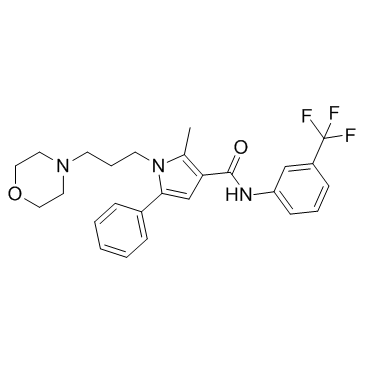
HC 067047 structure
|
Common Name | HC 067047 | ||
|---|---|---|---|---|
| CAS Number | 883031-03-6 | Molecular Weight | 471.51500 | |
| Density | N/A | Boiling Point | N/A | |
| Molecular Formula | C26H28F3N3O2 | Melting Point | N/A | |
| MSDS | Chinese USA | Flash Point | N/A | |
| Symbol |

GHS06 |
Signal Word | Danger | |
Use of HC 067047HC-067047 is a potent and selective TRPV4 antagonist with IC50s of 48 nM, 133 nM, and 17 nM for human, rat, and mouse TRPV4. |
| Name | 2-methyl-1-(3-morpholin-4-ylpropyl)-5-phenyl-N-[3-(trifluoromethyl)phenyl]pyrrole-3-carboxamide |
|---|---|
| Synonym | More Synonyms |
| Description | HC-067047 is a potent and selective TRPV4 antagonist with IC50s of 48 nM, 133 nM, and 17 nM for human, rat, and mouse TRPV4. |
|---|---|
| Related Catalog | |
| Target |
IC50: 48 nM (human TRPV4), 133 nM (rat TRPV4), 17 nM (mouse TRPV4)[1] |
| References |
| Molecular Formula | C26H28F3N3O2 |
|---|---|
| Molecular Weight | 471.51500 |
| Exact Mass | 471.21300 |
| PSA | 49.99000 |
| LogP | 5.77880 |
| InChIKey | NCZYSQOTAYFTNM-UHFFFAOYSA-N |
| SMILES | Cc1c(C(=O)Nc2cccc(C(F)(F)F)c2)cc(-c2ccccc2)n1CCCN1CCOCC1 |
| Storage condition | 2-8℃ |
| Symbol |
GHS06 |
|---|---|
| Signal Word | Danger |
| Hazard Statements | H301-H319 |
| Precautionary Statements | P301 + P310-P305 + P351 + P338 |
| RIDADR | UN 2811 6.1 / PGIII |
|
Angiotensin II induces membrane trafficking of natively expressed transient receptor potential vanilloid type 4 channels in hypothalamic 4B cells.
Am. J. Physiol. Regul. Integr. Comp. Physiol. 307(8) , R945-55, (2014) Transient receptor potential vanilloid family type 4 (TRPV4) channels are expressed in central neuroendocrine neurons and have been shown to be polymodal in other systems. We previously reported that ... |
|
|
Temperature oscillations drive cycles in the activity of MMP-2,9 secreted by a human trabecular meshwork cell line.
Invest. Ophthalmol. Vis. Sci. 56(2) , 1396-405, (2015) Aqueous humor inflow falls 50% during sleeping hours without proportional fall in IOP, partly reflecting reduced outflow facility. The mechanisms underlying outflow facility cycling are unknown. One o... |
|
|
Role of transient receptor potential and pannexin channels in cigarette smoke-triggered ATP release in the lung.
Thorax 69(12) , 1080-9, (2014) COPD is an inflammatory disease usually associated with cigarette smoking (CS) with an increasing global prevalence and no effective medication. Extracellular ATP is increased in the COPD affected lun... |
| HC-067047 |