Digalacturonic acid
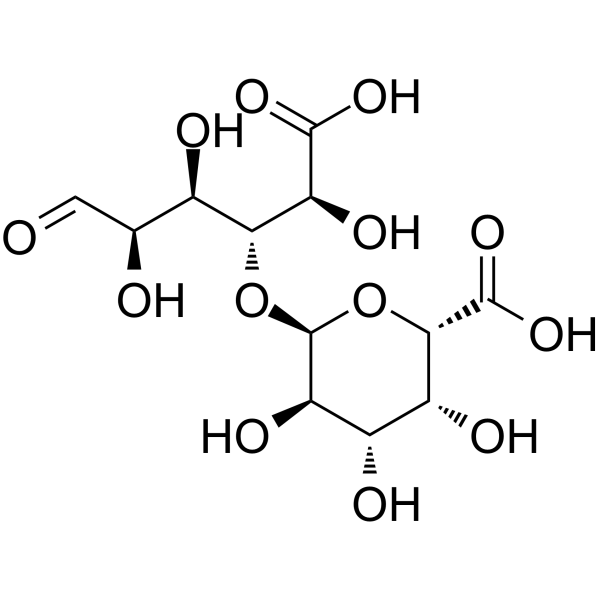
Digalacturonic acid structure
|
Common Name | Digalacturonic acid | ||
|---|---|---|---|---|
| CAS Number | 5894-59-7 | Molecular Weight | 370.26400 | |
| Density | 1.97 g/cm3 | Boiling Point | 793.8ºC at 760 mmHg | |
| Molecular Formula | C12H18O13 | Melting Point | N/A | |
| MSDS | Chinese USA | Flash Point | 296.6ºC | |
Use of Digalacturonic acidDigalacturonic acid is a metabolite of pectin or pectic acid. Digalacturonic acid can be used for the co-crystallization of enzymes such as proteinase K[1][2]. |
| Name | digalacturonic acid |
|---|---|
| Synonym | More Synonyms |
| Description | Digalacturonic acid is a metabolite of pectin or pectic acid. Digalacturonic acid can be used for the co-crystallization of enzymes such as proteinase K[1][2]. |
|---|---|
| Related Catalog | |
| Target |
Human Endogenous Metabolite |
| References |
| Density | 1.97 g/cm3 |
|---|---|
| Boiling Point | 793.8ºC at 760 mmHg |
| Molecular Formula | C12H18O13 |
| Molecular Weight | 370.26400 |
| Flash Point | 296.6ºC |
| Exact Mass | 370.07500 |
| PSA | 223.67000 |
| Index of Refraction | 1.682 |
| InChIKey | IGSYEZFZPOZFNC-LKIWRGPLSA-N |
| SMILES | O=C(O)C1OC(OC2C(C(=O)O)OC(O)C(O)C2O)C(O)C(O)C1O |
| Storage condition | -20°C |
| Personal Protective Equipment | Eyeshields;Gloves;type N95 (US);type P1 (EN143) respirator filter |
|---|---|
| RIDADR | NONH for all modes of transport |
|
Molecular characterization of a thermophilic endo-polygalacturonase from Thielavia arenaria XZ7 with high catalytic efficiency and application potential in the food and feed industries.
J. Agric. Food Chem. 62(52) , 12686-94, (2015) Thermophilic endo-polygalacturonases with high catalytic efficiency are of great interest in the food and feed industries. This study identified an endo-polygalacturonase gene (pg7fn) of glycoside hyd... |
|
|
Horizontal Gene Transfer of Pectinases from Bacteria Preceded the Diversification of Stick and Leaf Insects.
Sci. Rep. 6 , 26388, (2016) Genes acquired by horizontal transfer are increasingly being found in animal genomes. Understanding their origin and evolution requires knowledge about the phylogenetic relationships from both source ... |
|
|
Coordination ability of digalactosamine, and di- and trigalacturonic acids. Potentiometric and spectroscopic studies of Cu(II) complexes.
J. Inorg. Biochem. 57(1) , 1-10, (1995) Potentiometric and spectroscopic (EPR, CD, and absorption spectra) data obtained for digalactosamine and di- and trigalacturonic acid with Cu(II) have shown that the di-sugar binding is usually less e... |
| GALACTURONIC ACID ALPHA1,4-GALACTURONIC ACID |
| FURA-PE3 HEXAPOTASSIUM SALT |
| A-DGALU(1-4)DGALU |
| (2S,3R,4S,5R,6S)-6-[(2S,3R,4R,5R)-2-carboxy-4,5,6-trihydroxyoxan-3-yl]oxy-3,4,5-trihydroxyoxane-2-carboxylic acid |
| MFCD00079142 |
| 4]-D-GALA |
| GALA-ALPHA1,4GALA |