Delphinidin-3-sambubioside chloride
Modify Date: 2025-09-11 08:46:26
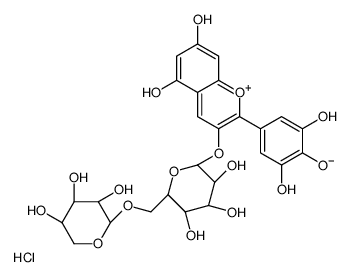
Delphinidin-3-sambubioside chloride structure
|
Common Name | Delphinidin-3-sambubioside chloride | ||
|---|---|---|---|---|
| CAS Number | 53158-73-9 | Molecular Weight | 632.95200 | |
| Density | N/A | Boiling Point | N/A | |
| Molecular Formula | C26H29ClO16 | Melting Point | N/A | |
| MSDS | N/A | Flash Point | N/A | |
Use of Delphinidin-3-sambubioside chlorideDelphinidin-3-sambubioside (Dp3‐Sam) chloride is an anthocyanin that has orally active anti-inflammatory activity. Delphinidin-3-sambubioside chloride inhibits LPS-induced inflammatory factors release. Delphinidin-3-sambubioside chloride also alleviates hepatic lipid accumulation in HFD rats. Delphinidin-3-sambubioside chloride can be isolated from Hibiscus sabdariffa L.[1][3]. |
| Name | delphinidin 3-O-β-D-sambubioside |
|---|---|
| Synonym | More Synonyms |
| Description | Delphinidin-3-sambubioside (Dp3‐Sam) chloride is an anthocyanin that has orally active anti-inflammatory activity. Delphinidin-3-sambubioside chloride inhibits LPS-induced inflammatory factors release. Delphinidin-3-sambubioside chloride also alleviates hepatic lipid accumulation in HFD rats. Delphinidin-3-sambubioside chloride can be isolated from Hibiscus sabdariffa L.[1][3]. |
|---|---|
| Related Catalog | |
| In Vitro | Delphinidin-3-sambubioside chloride (50-200 μM, 30 min) inhibits LPS-induced iNOS expression in RAW264.7 cells[1]. Delphinidin-3-sambubioside chloride (50-200 μM, 30 min) suppresses the phosphorylation of ERK1/2 and MEK1/2 in RAW264.7 cells[1]. Delphinidin-3-sambubioside chloride (50-200 μM, 30 min) downregulates NF-κB signaling pathway in RAW264.7 cells[1]. Delphinidin-3-sambubioside chloride (24 h) inhibits HL-60 cells proliferation by inducing apoptosis, with an IC50 of 75 μM[2]. Delphinidin-3-sambubioside chloride (100-200 µg/mL, 24 h) decreases intracellular TG levels and lipid accumulation in oleic acid-treated HepG2 cells[2]. Western Blot Analysis[1] Cell Line: RAW264.7 cells Concentration: 50, 100, 200 μM Incubation Time: 30 min Result: Suppressed the degradation of IκB, and the phosphorylation of p65. |
| In Vivo | Delphinidin-3-sambubioside chloride (15 μmol/kg, i.p.) inhibits mouse paw edema induced by LPS[1]. Delphinidin-3-sambubioside chloride (30 mg/kg body, oral gavage, daily for eight weeks) decreases lipid accumulation in HFD rats[3]. Animal Model: Delphinidin-3-sambubioside chloride (15 μmol/kg, i.p.) 抑制 LPS 诱导的小鼠爪水肿[1]. Delphinidin-3-sambubioside chloride (30 mg/kg body,灌胃,每日一次,持续八周) 减少 HFD 大鼠的脂质积累[3]。 Dosage: 15 μmol/kg Administration: Intraperitoneal injection (i.p.), for 4 days. Result: Reduced the LPS-induced paw thickness. Decreased the edema by 89.3%. Decreased the levels of LPS induced serum IL-6, MCP-1 and TNF-α. Animal Model: HFD-fed rats[3] Dosage: 30 mg/kg Administration: Oral gavage, daily for eight weeks. Result: Reduced the body weight gain, visceral fat, and abdominal fat and decreased hepatic lipid deposits. |
| References |
| Molecular Formula | C26H29ClO16 |
|---|---|
| Molecular Weight | 632.95200 |
| Exact Mass | 632.11400 |
| PSA | 275.42000 |
| InChIKey | TWYYVOVDSNRIJM-AFAGGVQESA-O |
| SMILES | OCC1OC(Oc2cc3c(O)cc(O)cc3[o+]c2-c2cc(O)c(O)c(O)c2)C(OC2OCC(O)C(O)C2O)C(O)C1O |
| Storage condition | 20°C |
| delphinidin 3-O-beta-D-sambubioside |
| 5,7-Dihydroxy-2-(3,4,5-trihydroxyphenyl)-3-chromeniumyl 6-O-β-D-x ylopyranosyl-β-D-glucopyranoside chloride |
The content on this webpage is sourced from various professional data sources. If you have any questions or concerns regarding the content, please feel free to contact service1@chemsrc.com.
- Shanghai Nianxing Industrial Co., Ltd
- China
- Product Name: Delphinidin-3-sambubioside chloride
- Price: Check
- Purity: 95.0%
- Delivery: 10 Day
- Contact: Yang
- Email: sales@echemcloud.com
- Shanghai Jizhi Biochemical Technology Co., Ltd
- China
- Product Name: Delphinidin-3-sambubioside chloride
- Price: ¥4418.0/5mg
- Purity: 98.0%
- Delivery: 2 Day
- Contact: Liu jia


- Email: 2130147988@qq.com
- DC Chemicals Limited
- China
- Product Name: Delphinidin-3-sambubioside chloride
- Price: $Inquiry/100mg $Inquiry/250mg $Inquiry/1g
- Purity: 98.0%
- Delivery: 3 Day
- Contact: Tony Cao
- Email: sales@dcchemicals.com
Get all suppliers and price by the below link: