Tricarbonyldichlororuthenium(II) dimer
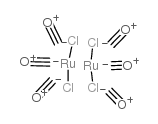
Tricarbonyldichlororuthenium(II) dimer structure
|
Common Name | Tricarbonyldichlororuthenium(II) dimer | ||
|---|---|---|---|---|
| CAS Number | 22594-69-0 | Molecular Weight | 512.01300 | |
| Density | N/A | Boiling Point | N/A | |
| Molecular Formula | C6Cl4O6Ru2 | Melting Point | 208ºC (dec.) | |
| MSDS | Chinese USA | Flash Point | N/A | |
| Symbol |

GHS07 |
Signal Word | Warning | |
Use of Tricarbonyldichlororuthenium(II) dimerTricarbonyldichlororuthenium(II) dimer is a pharmacological donor of CO releasing. CO releases from Tricarbonyldichlororuthenium(II) dimer prevents gastric mucosal oxidative damage induced by ischemia/reperfusion (I/R) improving gastric blood flow (GBF), decreasing DNA oxidation and inflammatory response on systemic level[1]. |
| Name | carbon monoxide,dichlororuthenium |
|---|---|
| Synonym | More Synonyms |
| Description | Tricarbonyldichlororuthenium(II) dimer is a pharmacological donor of CO releasing. CO releases from Tricarbonyldichlororuthenium(II) dimer prevents gastric mucosal oxidative damage induced by ischemia/reperfusion (I/R) improving gastric blood flow (GBF), decreasing DNA oxidation and inflammatory response on systemic level[1]. |
|---|---|
| Related Catalog | |
| References |
| Melting Point | 208ºC (dec.) |
|---|---|
| Molecular Formula | C6Cl4O6Ru2 |
| Molecular Weight | 512.01300 |
| Exact Mass | 511.65400 |
| LogP | 1.51000 |
| Appearance of Characters | crystal | off-white |
| InChIKey | JYHHJVKGDCZCCL-UHFFFAOYSA-J |
| SMILES | Cl[Ru]Cl.Cl[Ru]Cl.[C-]#[O+].[C-]#[O+].[C-]#[O+].[C-]#[O+].[C-]#[O+].[C-]#[O+] |
| Water Solubility | Insoluble in water |
| Symbol |
GHS07 |
|---|---|
| Signal Word | Warning |
| Hazard Statements | H302 + H312 + H332-H315-H319-H335 |
| Precautionary Statements | P261-P280-P305 + P351 + P338 |
| Personal Protective Equipment | dust mask type N95 (US);Eyeshields;Gloves |
| Hazard Codes | Xn: Harmful; |
| Risk Phrases | 20/21/22-36/37/38 |
| Safety Phrases | S24/25 |
| RIDADR | UN3466 |
| WGK Germany | 3 |
| Packaging Group | III |
| Hazard Class | 6.1 |
|
The CO donor CORM-2 inhibits LPS-induced vascular cell adhesion molecule-1 expression and leukocyte adhesion in human rheumatoid synovial fibroblasts.
Br. J. Pharmacol. 171(12) , 2993-3009, (2014) Infection with Gram-negative bacteria has been recognized as an initiator of rheumatoid arthritis, which is characterized by chronic inflammation and infiltration of immune cells. Carbon monoxide (CO)... |
|
|
Curcumin-induced heme oxygenase-1 expression prevents H2O2-induced cell death in wild type and heme oxygenase-2 knockout adipose-derived mesenchymal stem cells.
Int. J. Mol. Sci. 15(10) , 17974-99, (2014) Mesenchymal stem cell (MSC) administration is a promising adjuvant therapy to treat tissue injury. However, MSC survival after administration is often hampered by oxidative stress at the site of injur... |
|
|
Carbon monoxide (CO) is a novel inhibitor of connexin hemichannels.
J. Biol. Chem. 289(52) , 36150-7, (2014) Hemichannels (HCs) are hexamers of connexins that can form gap-junction channels at points of cell contacts or "free HCs" at non-contacting regions. HCs are involved in paracrine and autocrine cell si... |
| MFCD00011528 |
| corm-2 |