LEI 101 hydrochloride
Modify Date: 2025-09-05 18:39:50
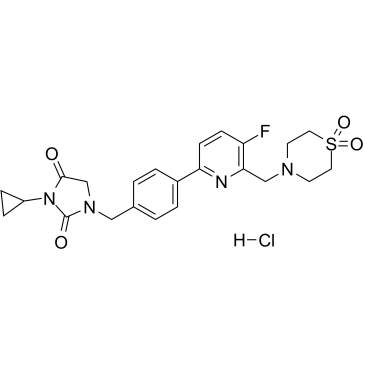
LEI 101 hydrochloride structure
|
Common Name | LEI 101 hydrochloride | ||
|---|---|---|---|---|
| CAS Number | 2250025-91-1 | Molecular Weight | 508.99 | |
| Density | N/A | Boiling Point | N/A | |
| Molecular Formula | C23H26ClFN4O4S | Melting Point | N/A | |
| MSDS | N/A | Flash Point | N/A | |
Use of LEI 101 hydrochlorideLEI-101 is a potent, selective, and orally bioavailable cannabinoid CB2 receptor agonist, with a pEC50 of 8 for hCB2, and a pKi of less than 4 for hERG. LEI-101 is ~100-fold more potent in binding to CB2 receptors than to CB1 receptors[1][2]. |
| Name | LEI-101 |
|---|
| Description | LEI-101 is a potent, selective, and orally bioavailable cannabinoid CB2 receptor agonist, with a pEC50 of 8 for hCB2, and a pKi of less than 4 for hERG. LEI-101 is ~100-fold more potent in binding to CB2 receptors than to CB1 receptors[1][2]. |
|---|---|
| Related Catalog | |
| In Vivo | LEI-101 (2, 6, and 20 mg/kg, po) shows in vivo activity in a spinal nerve ligation model of neuropathic pain in rats[1]. LEI‐101 (p.o. or i.p.) at 3 or 10 mg/kg dose-dependently prevents kidney dysfunction and/or morphological damage induced by cisplatin in mice[2]. Animal Model: Neuropathy-induced mechanical allodynia in male wistar rats[1]. Dosage: 2, 6, and 20 mg/kg. Administration: PO, single dose. Result: Induced a dose-dependent antinociceptive effect after 2 h of dosing. Animal Model: Fed male Wistar rats[1]. Dosage: 1 mg/kg iv and 5 mg/kg po (Pharmacological Analysis). Administration: IV and PO. Result: Exhibited T1/2 of 1.7 h and 0.8 h for po and iv administration. Had a low clearance and 100% oral bioavailability. |
| References |
| Molecular Formula | C23H26ClFN4O4S |
|---|---|
| Molecular Weight | 508.99 |