| Description |
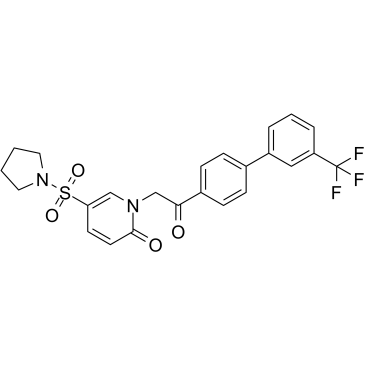
TBOPP is a selective inhibitor of DOCK1 with an IC50 of 8.4 μM. TBOPP binds to the DOCK1 DHR-2 domain with high affinity (Kd of 7.1 μM), has anti-tumor activity for broader types of tumors[1].
|
| Related Catalog |
|
| Target |
IC50: 8.4 μM (DOCK1); Kd: 7.1 μM (DOCK1 DHR-2 domain)[1]
|
| In Vitro |
TBOPP (12.5 µM; 3 days; 3LL cells) treatment inhibits DOCK1-mediated invasion, macropinocytosis, and survival under the condition of glutamine deprivation without impairing the biological functions of the closely related DOCK2 and DOCK5 proteins[1]. Cell Viability Assay[1] Cell Line: 3LL cells Concentration: 12.5 µM Incubation Time: 3 days Result: Inhibited cell viability.
|
| In Vivo |
TBOPP (0.67 mg per mouse; administrated on days 0, 1, 3, and 5; for 2 weeks; C57BL/6 mice) treatment effectively suppresses metastasis of cancer cells in vivo and the number of lymphocytes in the spleen is not changed, the body weight is also unchanged between TBOPP-treated and non-treated mice[1]. Animal Model: C57BL/6 mice (6- to 8-week-old) with ex-3LL cells[1] Dosage: 0.67 mg per mouse Administration: Administrated on days 0, 1, 3, and 5; for 2 weeks Result: The lung metastasis was significantly suppressed.
|
| References |
[1]. Tajiri H, et al. Targeting Ras-Driven Cancer Cell Survival and Invasion through Selective Inhibition of DOCK1. Cell Rep. 2017 May 2;19(5):969-980.
|