Enclomiphene hydrochloride
Modify Date: 2025-08-27 12:38:18
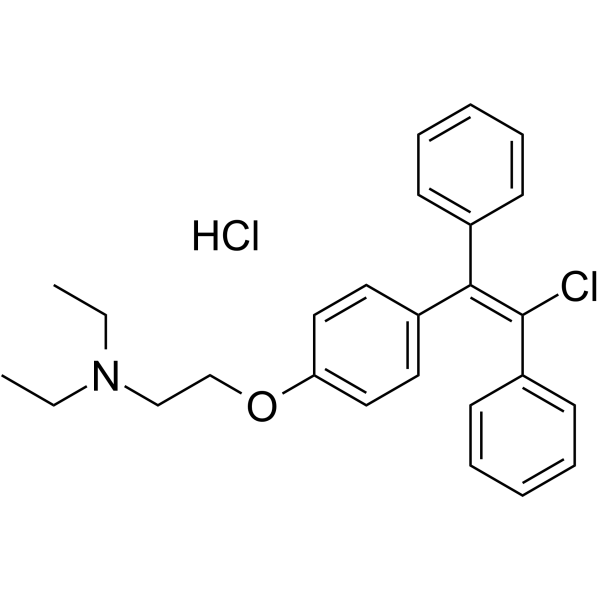
Enclomiphene hydrochloride structure
|
Common Name | Enclomiphene hydrochloride | ||
|---|---|---|---|---|
| CAS Number | 14158-65-7 | Molecular Weight | 442.42100 | |
| Density | N/A | Boiling Point | N/A | |
| Molecular Formula | C26H29Cl2NO | Melting Point | N/A | |
| MSDS | Chinese USA | Flash Point | N/A | |
Use of Enclomiphene hydrochlorideEnclomiphene ((E)-Clomiphene) hydrochloride is a potent and orally active non-steroidal estrogen receptor antagonist, with antioestrogenic property. Enclomiphene hydrochloride can be used for the research of ovarian dysfunction, testosterone deficiency, male hypogonadism and type 2 diabetes[1]. |
| Name | trans-Clomiphene Hydrochloride |
|---|---|
| Synonym | More Synonyms |
| Description | Enclomiphene ((E)-Clomiphene) hydrochloride is a potent and orally active non-steroidal estrogen receptor antagonist, with antioestrogenic property. Enclomiphene hydrochloride can be used for the research of ovarian dysfunction, testosterone deficiency, male hypogonadism and type 2 diabetes[1]. |
|---|---|
| Related Catalog | |
| In Vitro | Enclomiphene hydrochloride (0-100 μM, 6 h) dose-dependently inhibits basal and gonadotrophin-stimulated small and large ovine luteal cell progesterone secretion[2]. Enclomiphene hydrochloride (0-100 μg/mL, 24 h) dose-dependently inhibits fertilization rates, blastocyst formation rates, and degeneration rates in mouse oocytes[3]. Enclomiphene hydrochloride (1 nM-10 μM, 6 h) dose-dependently decreases E2-induced inhibition of follicle stimulating hormone (FSH) secretion in primary sheep pituitary cells[4]. |
| In Vivo | Enclomiphene hydrochloride (subcutaneous injection, 0.25 and 0.5 mg/animal, daily) inhibits spermatogenesis and decreases serum luteinizing hormone (LH) and testosterone levels in intact or castrated rats[5]. Enclomiphene hydrochloride (oral adminstration, 0.03-3 mg/kg, daily for 90 days) reductes body weight to sham levels, and reduced serum cholesterol[6]. Animal Model: 21 days-old Charles River male rats[5] Dosage: 0.25 and 0.5 mg/animal, daily for 24 days. Administration: Subcutaneous injection Result: Decreased LH and testosterone levels in the serum. Animal Model: OVX (ovariectomy) rat model[6] Dosage: 0.03, 1, and 3 mg/kg, daily for 90 days. Administration: Oral adminstration Result: Reducted body weight to sham levels, and reduced serum cholesterol. Showed dose-dependent effects on the proximal tibia with BMD and BMC approaching posttreatment Sham levels. |
| References |
| Molecular Formula | C26H29Cl2NO |
|---|---|
| Molecular Weight | 442.42100 |
| Exact Mass | 441.16300 |
| PSA | 12.47000 |
| LogP | 7.36460 |
| InChIKey | KKBZGZWPJGOGJF-BTKVJIOYSA-N |
| SMILES | CCN(CC)CCOc1ccc(C(=C(Cl)c2ccccc2)c2ccccc2)cc1.Cl |
| RIDADR | NONH for all modes of transport |
|---|
|
Bone Mineral Density and Response to Treatment in Men Younger Than 50 Years with Testosterone Deficiency and Sexual Dysfunction or Infertility
J. Urol. 191(4) , 1072-6, (2014) Purpose Testosterone deficiency is a known risk factor for osteopenia and osteoporosis in older men. Less is known about the impact of testosterone deficiency on bone mineral density in younger men. |
|
|
Progesterone luteal support after ovulation induction and intrauterine insemination: a systematic review and meta-analysis
Fertil. Steril. 100(5) , 1373-80, (2013) Objective To evaluate the effect of luteal phase P support after ovulation induction IUI. |
|
|
Re: Optimization of Spermatogenesis-Regulating Hormones in Patients with Non-Obstructive Azoospermia and its Impact on Sperm Retrieval: A Multicentre Study
J. Urol. 190(6) , 2209, (2013)
|
| Enclomiphene hydrochloride |
| 2-[4-[(E)-2-chloro-1,2-diphenylethenyl]phenoxy]-N,N-diethylethanamine,hydrochloride |