4-(4-((4-Chlorophenyl)(pyridin-2-yl)methoxy)piperidin-1-yl)butanoicacidcompoundwithbenzenesulfonicacid(1:1)
Modify Date: 2025-11-04 08:45:39
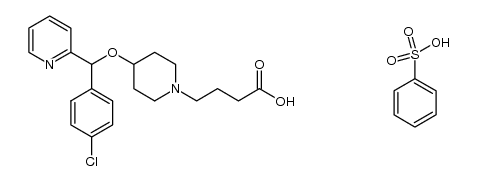
4-(4-((4-Chlorophenyl)(pyridin-2-yl)methoxy)piperidin-1-yl)butanoicacidcompoundwithbenzenesulfonicacid(1:1) structure
|
Common Name | 4-(4-((4-Chlorophenyl)(pyridin-2-yl)methoxy)piperidin-1-yl)butanoicacidcompoundwithbenzenesulfonicacid(1:1) | ||
|---|---|---|---|---|
| CAS Number | 1415692-17-9 | Molecular Weight | 547.06 | |
| Density | N/A | Boiling Point | N/A | |
| Molecular Formula | C27H31ClN2O6S | Melting Point | N/A | |
| MSDS | N/A | Flash Point | N/A | |
Use of 4-(4-((4-Chlorophenyl)(pyridin-2-yl)methoxy)piperidin-1-yl)butanoicacidcompoundwithbenzenesulfonicacid(1:1)(Rac)-Bepotastine (besilate) is the inactive isomer of Bepotastine (besilate) (HY-A0015), and can be used as an experimental control. Bepotastine besilate is a selective and orally active second-generation histamine H1 receptor antagonist, can suppress the expression of nerve growth factor (NGF). Bepotastine besilate has the potential for allergic rhinitis, allergic conjunctivitis and urticaria/pruritus research[1][2][3][4]. |
| Name | bepotastine besilate |
|---|
| Description | (Rac)-Bepotastine (besilate) is the inactive isomer of Bepotastine (besilate) (HY-A0015), and can be used as an experimental control. Bepotastine besilate is a selective and orally active second-generation histamine H1 receptor antagonist, can suppress the expression of nerve growth factor (NGF). Bepotastine besilate has the potential for allergic rhinitis, allergic conjunctivitis and urticaria/pruritus research[1][2][3][4]. |
|---|---|
| Related Catalog | |
| References |
| Molecular Formula | C27H31ClN2O6S |
|---|---|
| Molecular Weight | 547.06 |
| Exact Mass | 546.15900 |
| PSA | 125.41000 |
| LogP | 6.12220 |
| InChIKey | UDGHXQPQKQPSBB-UHFFFAOYSA-N |
| SMILES | O=C(O)CCCN1CCC(OC(c2ccc(Cl)cc2)c2ccccn2)CC1.O=S(=O)(O)c1ccccc1 |
| Precursor 0 | |
|---|---|
| DownStream 1 | |
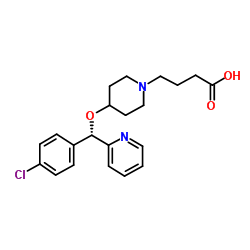 CAS#:125602-71-3