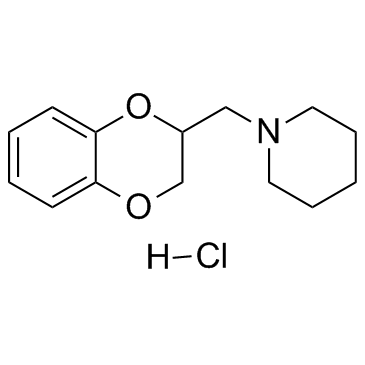
Piperoxan hydrochloride

Modify Date: 2025-08-25 06:35:40

Piperoxan hydrochloride Structure
Piperoxan hydrochloride structure
Common Name Piperoxan hydrochloride
CAS Number 135-87-5 Molecular Weight 269.76700
Density 1.113g/cm3 Boiling Point 331.5ºC at 760mmHg
Molecular Formula C14H20ClNO2 Melting Point N/A
MSDS N/A Flash Point 118.1ºC

 Use of Piperoxan hydrochloride


Piperoxan hydrochloride is an α2 adrenoceptor antagonist.

 Names

Name 1-[(2,3-dihydro-1,4-benzodioxin-2-yl)methyl]piperidinium chloride
Synonym More Synonyms

 Piperoxan hydrochloride Biological Activity

Description Piperoxan hydrochloride is an α2 adrenoceptor antagonist.
Related Catalog
Target

adrenoceptor[1]

In Vitro When the medulla is superfused with α2 adrenoceptor antagonist Piperoxane (50 μM; 5 min) while the pons is with artificial cerebrospinal fluid (ACSF), the three inactive preparations display rhythmic phrenic bursts at a low frequency (2-4 c/min), and the phrenic burst frequency of the 12 active ones significantly increases during the last 3 min of Piperoxane applications (163±12% of the previous mean frequency). In active medullary preparations, the effects of NA applications (25 μM; 5 min) are compared when the preparations sre superfused either by ACSF (n=8) or by the α2 adrenoceptor antagonist Piperoxane (50 μM; PIP-ACSF; n=5). NA applications either alone (NA-ACSF) or with Piperoxane (PIP-ACSF+NA) significantly increases the phrenic burst frequency. However, the blockage of the medullary α2 adrenoceptors by Piperoxane potentiates a phrenic burst frequency increase: during the fifth minute of NA applications, the phrenic burst frequency reached 171±11% of the mean control value when ACSF is applied alone and 234±21% of the mean control value when PIP-ACSF is applied in control condition[1].
Kinase Assay The mouse neonates (P0-P3) are ether-anesthetized and decerebrated; the brain stems and the cervical spinal cords are dissected out and placed ventral sides up in a 2 mL chamber superfused with artificial cerebrospinal fluid (ACSF) at 27±0.25°C (mean±SD), renewed at a rate of 2 mL/min. The ACSF [containing (in mM) 129 NaCl, 3.35 KCl, 1.26 CaCl2, 1.15 MgCl2, 21 NaHCO3, 0.58 NaH2PO4, and 30 glucose] is oxygenated and equilibrated (pH 7.4 at 27°C) by bubbling carbogene (95% O2-5% CO2). In the pharmacological experiments, this is replaced by another ACSF in which bioreactive substances are dissolved: noradrenaline at 25 μM (NA-ACSF) or α2 adrenoceptor antagonists, either Piperoxane at 50 μM (PIP-ACSF) or yohimbine at 50 μM (YO-ACSF). In some of the experiments, a patch-clamp microelectrode (1 μm diameter tip) is lowered within the ventral pons into the A5 nucleus where a solution of either ACSF or NA (1 mM) is pressure-ejected. The ejected volume is estimated 20 nL for a pressure pulse lasting 2 s[1].
Animal Admin Mice[2] Male Balb-C mice are used, weighing between 20 and 25 g. In mice pretreated with the α-adrenoceptor antagonist Piperoxan, or with naloxone, both at a dose of 3×10⁻⁵ mol /kg s.c. given 15 min before the acetic acid, the antinociceptive action of (-)-isoprenaline is only slightly antagonized. Dose-ratios of 1.45 and 1.7, are produced by these two antagonists.
References

[1]. Viemari JC, et al. Nasal trigeminal inputs release the A5 inhibition received by the respiratory rhythm generator of the mouse neonate. J Neurophysiol. 2004 Feb;91(2):746-58.

[2]. Bentley GA, et al. The antinociceptive action of some beta-adrenoceptor agonists in mice. Br J Pharmacol. 1986 Jul;88(3):515-21.

 Chemical & Physical Properties

Density 1.113g/cm3
Boiling Point 331.5ºC at 760mmHg
Molecular Formula C14H20ClNO2
Molecular Weight 269.76700
Flash Point 118.1ºC
Exact Mass 269.11800
PSA 21.70000
LogP 3.05220
Vapour Pressure 0.000155mmHg at 25°C
InChIKey BITRJBQGQMGGQI-UHFFFAOYSA-N
SMILES Cl.c1ccc2c(c1)OCC(CN1CCCCC1)O2

 Toxicological Information

CHEMICAL IDENTIFICATION

RTECS NUMBER :
TM4550000
CHEMICAL NAME :
Piperidine, 1-(1,4-benzodioxan-2-ylmethyl)-, hydrochloride
CAS REGISTRY NUMBER :
135-87-5
LAST UPDATED :
199509
DATA ITEMS CITED :
6
MOLECULAR FORMULA :
C14-H19-N-O2.Cl-H
MOLECULAR WEIGHT :
269.80
WISWESSER LINE NOTATION :
T66 BO EOT&J C1- AT6NTJ &GH

HEALTH HAZARD DATA

ACUTE TOXICITY DATA

TYPE OF TEST :
LD50 - Lethal dose, 50 percent kill
ROUTE OF EXPOSURE :
Oral
SPECIES OBSERVED :
Rodent - mouse
DOSE/DURATION :
502 mg/kg
TOXIC EFFECTS :
Behavioral - tremor Behavioral - convulsions or effect on seizure threshold Behavioral - excitement
REFERENCE :
JAPMA8 Journal of the American Pharmaceutical Association, Scientific Edition. (Washington, DC) V.29-49, 1940-60. For publisher information, see JPMSAE. Volume(issue)/page/year: 48,409,1959
TYPE OF TEST :
LD50 - Lethal dose, 50 percent kill
ROUTE OF EXPOSURE :
Intraperitoneal
SPECIES OBSERVED :
Rodent - mouse
DOSE/DURATION :
175 mg/kg
TOXIC EFFECTS :
Behavioral - tremor Behavioral - convulsions or effect on seizure threshold Behavioral - excitement
REFERENCE :
JAPMA8 Journal of the American Pharmaceutical Association, Scientific Edition. (Washington, DC) V.29-49, 1940-60. For publisher information, see JPMSAE. Volume(issue)/page/year: 48,409,1959
TYPE OF TEST :
LD50 - Lethal dose, 50 percent kill
ROUTE OF EXPOSURE :
Subcutaneous
SPECIES OBSERVED :
Rodent - mouse
DOSE/DURATION :
500 mg/kg
TOXIC EFFECTS :
Behavioral - analgesia
REFERENCE :
THERAP Therapie. (Doin, Editeurs, 8, Place de l'Odeon, F-75006 Paris, France) V.1- 1946- Volume(issue)/page/year: 13,17,1958
TYPE OF TEST :
LD50 - Lethal dose, 50 percent kill
ROUTE OF EXPOSURE :
Intravenous
SPECIES OBSERVED :
Rodent - mouse
DOSE/DURATION :
26 mg/kg
TOXIC EFFECTS :
Details of toxic effects not reported other than lethal dose value
REFERENCE :
AIPTAK Archives Internationales de Pharmacodynamie et de Therapie. (Heymans Institute of Pharmacology, De Pintelaan 185, B-9000 Ghent, Belgium) V.4- 1898- Volume(issue)/page/year: 105,221,1956 ** REPRODUCTIVE DATA **
TYPE OF TEST :
TDLo - Lowest published toxic dose
ROUTE OF EXPOSURE :
Oral
DOSE :
735 mg/kg
SEX/DURATION :
female 3-9 day(s) after conception
TOXIC EFFECTS :
Reproductive - Fertility - pre-implantation mortality (e.g. reduction in number of implants per female; total number of implants per corpora lutea)
REFERENCE :
PSEBAA Proceedings of the Society for Experimental Biology and Medicine. (Academic Press, Inc., 1 E. First St., Duluth, MN 55802) V.1- 1903/04- Volume(issue)/page/year: 100,555,1959
TYPE OF TEST :
TDLo - Lowest published toxic dose
ROUTE OF EXPOSURE :
Intramuscular
DOSE :
250 mg/kg
SEX/DURATION :
female 5 day(s) after conception
TOXIC EFFECTS :
Reproductive - Fertility - pre-implantation mortality (e.g. reduction in number of implants per female; total number of implants per corpora lutea)
REFERENCE :
PSEBAA Proceedings of the Society for Experimental Biology and Medicine. (Academic Press, Inc., 1 E. First St., Duluth, MN 55802) V.1- 1903/04- Volume(issue)/page/year: 100,555,1959

 Synonyms

1-(1,4-Benzodioxan-2-ylmethyl)piperidine hydrochloride
Benzodioxane hydrochloride
Benodaine hydrochloride
EINECS 205-222-3
933F Hydrochloride
933F
2-Piperidinomethyl-1,4-benzodioxan hydrochloride
1,4-Benzodioxan,2-(1-piperidylmethyl)-,hydrochloride
2-(1-Piperidylmethyl)-1,4-benzodioxan hydrochloride
Piperoxan hydrochloride
Piperoxan (hydrochloride)
The content on this webpage is sourced from various professional data sources. If you have any questions or concerns regarding the content, please feel free to contact service1@chemsrc.com.
Top Suppliers:I want be here


Get all suppliers and price by the below link:

Piperoxan hydrochloride suppliers


Price: $160/10mM*1mLinDMSO

Reference only. check more Piperoxan hydrochloride price