Glucokinase activator 1
Modify Date: 2025-09-01 15:50:33
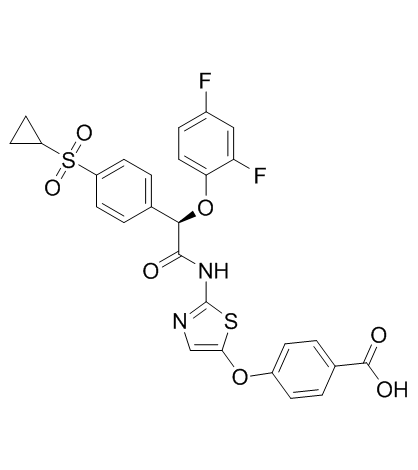
Glucokinase activator 1 structure
|
Common Name | Glucokinase activator 1 | ||
|---|---|---|---|---|
| CAS Number | 1328987-85-4 | Molecular Weight | 586.58 | |
| Density | N/A | Boiling Point | N/A | |
| Molecular Formula | C27H20F2N2O7S2 | Melting Point | N/A | |
| MSDS | N/A | Flash Point | N/A | |
Use of Glucokinase activator 1Glucokinase activator 1 is a liver-directed glucokinase activator with an EC50 of 34 nM. |
| Name | Glucokinase activator 1 |
|---|
| Description | Glucokinase activator 1 is a liver-directed glucokinase activator with an EC50 of 34 nM. |
|---|---|
| Related Catalog | |
| Target |
EC50: 34 nM (Glucokinase)[1] |
| In Vivo | Glucokinase activator 1 (3 to 300 mg/kg, oral, 180 minutes) shows a dose dependent improvement in glucose excursion in oGTT in a DIO mouse model of T2D. The predominant liver-directed tissue distribution of Glucokinase activator 1 ensures a good safety window with respect to hypoglycemia over a 10-fold dose range[1]. Animal Model: Male C57BL/6J mice (age 8-10 weeks; 25±5 g)[1] Dosage: 1 or 3 mg/kg (i.v.), 30 mg/kg (oral) Administration: i.v. or oral Result: Glucokinase activator 1 shows an excellent PK profile and exhibited 35- and 68- fold higher liver concentrations at 1 and 3 h time point, respectively, compared with plasma[1]. Animal Model: Male C57BL/6J mice of 10-12 weeks[1] Dosage: 3 to 300 mg/kg Administration: Oral (15, 30, 60, 120 and 180 minutes) Result: Glucokinase activator 1 demonstrates 21% and 34% significant AUCglucose reduction at oral dose of 30 and 100 mg/kg, respectively[1]. |
| References |
| Molecular Formula | C27H20F2N2O7S2 |
|---|---|
| Molecular Weight | 586.58 |
| InChIKey | XJFUEUNGZVAEIX-XMMPIXPASA-N |
| SMILES | O=C(O)c1ccc(Oc2cnc(NC(=O)C(Oc3ccc(F)cc3F)c3ccc(S(=O)(=O)C4CC4)cc3)s2)cc1 |