GLP-1 (7-36) amide (human, bovine, guinea pig, mouse, rat) trifluoroacetate salt
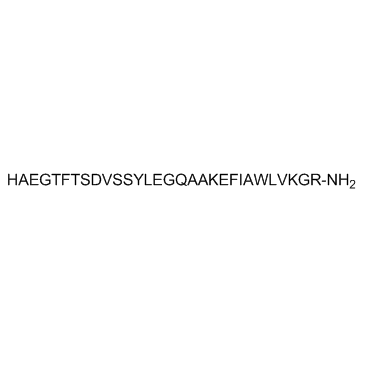
GLP-1 (7-36) amide (human, bovine, guinea pig, mouse, rat) trifluoroacetate salt structure
|
Common Name | GLP-1 (7-36) amide (human, bovine, guinea pig, mouse, rat) trifluoroacetate salt | ||
|---|---|---|---|---|
| CAS Number | 107444-51-9 | Molecular Weight | 3297.630 | |
| Density | 1.5±0.1 g/cm3 | Boiling Point | N/A | |
| Molecular Formula | C149H226N40O45 | Melting Point | N/A | |
| MSDS | USA | Flash Point | N/A | |
Use of GLP-1 (7-36) amide (human, bovine, guinea pig, mouse, rat) trifluoroacetate saltGlucagon-Like Peptide (GLP) I (7-36), amide, human is a physiological incretin hormone that stimulates insulin secretion. |
| Name | L-Histidyl-L-alanyl-L-α-glutamylglycyl-L-threonyl-L-phenylalanyl-L-threonyl-L-seryl-L-α-aspartyl-L-valyl-L-seryl-L-seryl-L-tyrosyl-L-leucyl-L-α-glutamylglycyl-L-glutaminyl-L-alanyl-L-alanyl-L-lysyl-L-α-glutamyl-L-phenylalanyl-L-isoleucyl-L-alanyl-L-tryptophyl-L-leucyl-L-valyl-L-lysylglycyl-L-argininamide |
|---|---|
| Synonym | More Synonyms |
| Description | Glucagon-Like Peptide (GLP) I (7-36), amide, human is a physiological incretin hormone that stimulates insulin secretion. |
|---|---|
| Related Catalog | |
| In Vitro | The sequence of Glucagon-Like Peptide after residue 7 shows similarities to glucagon and to other biologically active members of the secretin peptide family, particularly glucose-dependent insulinotropic peptide (GIP). This sequence has been especially well preserved, showing 66% nucleotide homology with GLP-1 in the proglucagon of the very primitive anglerfish. This 7-36 sequence of GLP-1 is a potent insulin-releasing peptide in vitro[1]. Glucagon-Like Peptide (GLP) I (7-36), amide is a product of the tissue-specific post-translational processing of the glucagon precursor. It is released postprandially from intestinal endocrine L cells and stimulates insulin secretion. DPP IV is the main degradation enzyme for GLP-l(7 - 36)amide in human serum. Dipeptidyl-peptidase IV can initiate the metabolism of GIP and GLP-1(7-36)amide in human serum[2]. |
| In Vivo | Glucagon-Like Peptide (GLP) I (7-36), amide is a physiological incretin hormone that is released after nutrient intake from the lower gut and stimulates insulin secretion at elevated plasma glucose concentrations. Exogenous GLP-1 (7-36 amide) is an effective means of normalizing fasting plasma glucose concentrations in poorly-controlled Type 2 diabetic subjects[3]. Exogenously administered GLP-1-(7–36)amide is extremely labile in vivo, with more than 80% being cleaved into GLP-1-(9–36)amide after sc or iv administration[4]. |
| Cell Assay | To test whether there is GLP-1-degrading activity in the perfusion medium itself, synthetic Glucagon-Like Peptide (GLP) I (7-36), amide is incubated (30 min at 37°C) in vitro with medium collected from the arterial line (i.e. before it passed through the tissue) and from the venous line, and subjected to HPLC and RIA analysis [4]. |
| References |
| Density | 1.5±0.1 g/cm3 |
|---|---|
| Molecular Formula | C149H226N40O45 |
| Molecular Weight | 3297.630 |
| Exact Mass | 3295.662598 |
| PSA | 1385.09000 |
| LogP | -4.86 |
| Index of Refraction | 1.660 |
| InChIKey | DTHNMHAUYICORS-KTKZVXAJSA-N |
| SMILES | CCC(C)C(NC(=O)C(Cc1ccccc1)NC(=O)C(CCC(=O)O)NC(=O)C(CCCCN)NC(=O)C(C)NC(=O)C(C)NC(=O)C(CCC(N)=O)NC(=O)CNC(=O)C(CCC(=O)O)NC(=O)C(CC(C)C)NC(=O)C(Cc1ccc(O)cc1)NC(=O)C(CO)NC(=O)C(CO)NC(=O)C(NC(=O)C(CC(=O)O)NC(=O)C(CO)NC(=O)C(NC(=O)C(Cc1ccccc1)NC(=O)C(NC(=O)CNC(=O)C(CCC(=O)O)NC(=O)C(C)NC(=O)C(N)Cc1c[nH]cn1)C(C)O)C(C)O)C(C)C)C(=O)NC(C)C(=O)NC(Cc1c[nH]c2ccccc12)C(=O)NC(CC(C)C)C(=O)NC(C(=O)NC(CCCCN)C(=O)NCC(=O)NC(CCCNC(=N)N)C(N)=O)C(C)C |
| Personal Protective Equipment | Eyeshields;Gloves;type N95 (US);type P1 (EN143) respirator filter |
|---|---|
| RIDADR | NONH for all modes of transport |
| WGK Germany | 3 |
|
Lys9 for Glu9 substitution in glucagon-like peptide-1(7-36)amide confers dipeptidylpeptidase IV resistance with cellular and metabolic actions similar to those of established antagonists glucagon-like peptide-1(9-36)amide and exendin (9-39).
Metab. Clin. Exp. 53(2) , 252-9, (2004) The incretin hormone glucagon-like peptide-1(7-36)amide (GLP-1) has been deemed of considerable importance in the regulation of blood glucose. Its effects, mediated through the regulation of insulin, ... |
|
|
Coexpression of glucagon-like peptide-1 (GLP-1) receptor, vasopressin, and oxytocin mRNAs in neurons of the rat hypothalamic supraoptic and paraventricular nuclei: effect of GLP-1(7-36)amide on vasopressin and oxytocin release.
J. Neurochem. 72(1) , 10-6, (1999) This study was designed to gain better insight into the relationship between glucagon-like peptide-1 (GLP-1) (7-36) amide and vasopressin (AVP) and oxytocin (OX). In situ hybridization histochemistry ... |
|
|
Elevated post-prandial gastric inhibitory polypeptide concentrations in hypertriglyceridaemic subjects.
Clin. Sci. 93(4) , 343-7, (1997) 1. We investigated whether abnormalities of gastric inhibitory polypeptide (GIP) and glucagon-like peptide-1 (7-36 amide) (GLP-1) contribute to the hypertriglyceridaemia and hyperinsulinaemia in hyper... |
| Preproglucagon 78-107 Amide |
| L-Argininamide, L-histidyl-L-alanyl-L-α-glutamylglycyl-L-threonyl-L-phenylalanyl-L-threonyl-L-seryl-L-α-aspartyl-L-valyl-L-seryl-L-seryl-L-tyrosyl-L-leucyl-L-α-glutamylglycyl-L-glutaminyl-
 L-alanyl-L-alanyl-L-lysyl-L-α-glutamyl-L-phenylalanyl-L-isoleucyl-L-alanyl-L-tryptophyl-L-leucyl-L-valyl-L-lysylglycyl- |
| L-Histidyl-L-alanyl-L-α-glutamylglycyl-L-threonyl-L-phenylalanyl-L-threonyl-L-seryl-L-α-aspartyl-L-valyl-L-seryl-L-seryl-L-tyrosyl-L-leucyl-L-α-glutamylglycyl-L-glutaminyl-L-alanyl-L-alany
 l-L-lysyl-L-α-glutamyl-L-phenylalanyl-L-isoleucyl-L-alanyl-L-tryptophyl-L-leucyl-L-valyl-L-lysylglycyl-L-argininamide |
| MFCD00133373 |
| UNII-0JS9125PIZ |
| MKC 253 |
| GLP-1 (7-36) amide Acetate |
| HIS-ALA-GLU-GLY-THR-PHE-THR-SER-ASP-VAL-SER-SER-TYR-LEU-GLU-GLY-GLN-ALA-ALA-LYS-GLU-PHE-ILE-ALA-TRP-LEU-VAL-LYS-GLY-ARG-NH2 |
| Glucagon-Like Peptide (GLP) I (7-36), amide, human |
The content on this webpage is sourced from various professional data sources. If you have any questions or concerns regarding the content, please feel free to contact service1@chemsrc.com.
- Shanghai Nianxing Industrial Co., Ltd
- China
- Product Name: GLP-1 (7-36) amide (human, bovine, guinea pig, mouse, rat) trifluoroacetate salt
- Price: Check
- Purity: 98.0%
- Delivery: 10 Day
- Contact: Yang
- Email: sales@echemcloud.com
- ShangHai DC Chemicals Co.,Ltd
- China
- Product Name: GLP-17-3
- Price: ¥Inquiry/1g
- Purity: 98.9%
- Delivery: 1 Day
- Contact: Tony Lai
- Email: order@dcchemicals.com
- DC Chemicals Limited
- China
- Product Name: GLP-17-3
- Price: $1500.0/100mg $3000.0/250mg $6000.0/1g
- Purity: 98.0%
- Delivery: 3 Day
- Contact: Tony Cao
- Email: sales@dcchemicals.com
- Nanjing Peptide Biotech Ltd
- China
- Product Name: GLP-1-(7-36) amide
- Price: ¥Inquiry/10g ¥Inquiry/100g ¥Inquiry/1kg ¥Inquiry/10kg
- Purity: 98.0%
- Delivery: 7 Day
- Contact: jom


- Email: chenglong.fan@njpeptide.com
- Henan Tianfu Chemical Co., Ltd.
- China
- Product Name: TIANFU CHEM GLUCAGON-LIKE PEPTIDE I FRAGMENT 7-36 AMIDE HUMAN
- Price: $Inquiry/1kg $Inquiry/25kg $Inquiry/1000kg $Inquiry/10ton
- Purity: 99.0%
- Delivery: Inquiry
- Contact: Anson
- Email: info@tianfuchem.com
Get all suppliers and price by the below link:
GLP-1 (7-36) amide (human, bovine, guinea pig, mouse, rat) trifluoroacetate salt suppliers
Reference only. check more GLP-1 (7-36) amide (human, bovine, guinea pig, mouse, rat) trifluoroacetate salt price