1038915-58-0
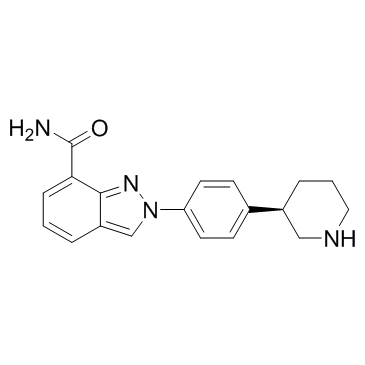
1038915-58-0 structure
- Name: MK-4827 (R-enantiomer)
- Chemical Name: 2-{4-[(3S)-piperidin-3-yl]phenyl}-2H-indazole-7-carboxamide
- CAS Number: 1038915-58-0
- Molecular Formula: C19H20N4O
- Molecular Weight: 320.38800
- Catalog: Research Areas Cancer
- Create Date: 2016-03-04 09:31:28
- Modify Date: 2026-07-27 06:22:53
-
Niraparib R-enantiomer (MK-4827 R-enantiomer) is an excellent PARP1 inhibitor with IC50 of 2.4 nM.
| Name | 2-{4-[(3S)-piperidin-3-yl]phenyl}-2H-indazole-7-carboxamide |
|---|---|
| Synonyms |
ent-Nirapanib
2H-Indazole-7-cboxamide, 2-[4-(3R)-3-piperidinylphenyl] (R)-Nirapib Nirapib (R-enantiomer), 10 mM in DMSO Nirapib R-enantiomer p-tosylate Nirapib Impurity 2-{4-[(3S)-piperidin-3-yl]phenyl}-2H-indazole-7-cboxamide 2-{4-[(3R)-piperidin-3-yl]phenyl}-2H-indazole-7-carboxamide R isomer of MK-4827, Nirapib (R)-2-(4-(PIPERIDIN-3-YL)PHENYL)-2H-INDAZOLE-7-CBOXAMIDE Nirapib Impurity 51 Nirapib R-enantiomer ent-Nirapib Nirapib Impurity 13 MK-4827 (R-enantioMer) poly ADP ribose polymerase,Inhibitor,Nirapib (R enantiomer),PP,Nirapib (Renantiomer),Nirapib (R-enantiomer),inhibit |
| Description | Niraparib R-enantiomer (MK-4827 R-enantiomer) is an excellent PARP1 inhibitor with IC50 of 2.4 nM. |
|---|---|
| Related Catalog | |
| Target |
PARP-1:2.4 nM (IC50) |
| In Vitro | Niraparib R-enantiomer (MK-4827 R-enantiomer) resolution of Niraparib R-enantiomer give compounds Niraparib R-enantiomer and Niraparib S-enantiomer, both showing excellent inhibition of PARP-1. Niraparib R-enantiomer has somewhat lower in vitro metabolic clearance than the Niraparib S-enantiomer in rat liver microsomes, but Niraparib S-enantiomer is more potent in cell based assays (PARylation EC50, Niraparib R-enantiomer=30 nM, Niraparib S-enantiomer=4.0 nM; BRCA1-HeLa CC50, Niraparib R-enantiomer=470, Niraparib S-enantiomer=34 nM). Given this improved potency and similar in vitro turnover in human liver microsomes (HLM Clint, Niraparib R-enantiomer=4, Niraparib S-enantiomer=3 μL/min/mgP), Niraparib S-enantiomer (Niraparib) is focused on[1]. |
| References |
| Molecular Formula | C19H20N4O |
|---|---|
| Molecular Weight | 320.38800 |
| Exact Mass | 320.16400 |
| PSA | 72.94000 |
| LogP | 3.62050 |