1332075-63-4
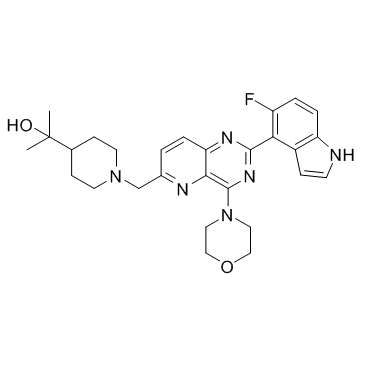
1332075-63-4 structure
- Name: PI3kδ inhibitor 1
- Chemical Name: 2-[1-[[2-(5-fluoro-1H-indol-4-yl)-4-morpholin-4-ylpyrido[3,2-d]pyrimidin-6-yl]methyl]piperidin-4-yl]propan-2-ol
- CAS Number: 1332075-63-4
- Molecular Formula: C28H33FN6O2
- Molecular Weight: 504.59900
- Catalog: Research Areas Cancer
- Create Date: 2017-10-09 00:56:23
- Modify Date: 2025-08-26 01:12:36
-
PI3kδ inhibitor 1 is a potent and selective PI3Kδ inhibitor with an IC50 of 3.8 nM.
| Name | 2-[1-[[2-(5-fluoro-1H-indol-4-yl)-4-morpholin-4-ylpyrido[3,2-d]pyrimidin-6-yl]methyl]piperidin-4-yl]propan-2-ol |
|---|---|
| Synonyms |
0SC
CS-0675 PI3k|A inhibitor 1| PI3k-delta inhibitor 1 PI3kδ inhibitor 1 |
| Description | PI3kδ inhibitor 1 is a potent and selective PI3Kδ inhibitor with an IC50 of 3.8 nM. |
|---|---|
| Related Catalog | |
| Target |
PI3Kδ:3.8 nM (IC50) |
| In Vitro | PI3kδ inhibitor 1 (Compound 3) is a potent inhibitor of PI3Kδ that is 200-400 fold selective for all three remaining Class I PI3K isoforms and extremely selective relative to 239 kinases tested in SelectScreen service (0/239 kinases showing >50% inhibition when tested at 1 μM; mTOR, DNA-PK, VPS34, PI4Kα and PI4Kβ are inhibited at 10% or less when tested at 1 μM; PIKC2A and PIKC2B are inhibited at 11% and 42%, respectively, at this same concentration and show less than 10% inhibition when tested at 0.1 μM; the PIKK family kinases ATM and ATR are not assessed)[1]. |
| In Vivo | The pharmacokinetic properties of PI3kδ inhibitor 1 (Compound 3) are evaluated in mice and rats when dosed IV and orally. Good plasma exposures and reasonable half-lives are observed upon oral dosing, a reflection of high oral bioavailability (80% and 90% at a low dose for mouse and rat, respectively), moderate volume of distribution, and moderate clearance. PI3kδ inhibitor 1 has moderate terminal elimination half-life (t1/2=2.6 h, 2.9 h, 5 h, 2.6, 3.8 and 4.8 h for mouse (5 mg/kg, po), mouse (20 mg/kg, po), mouse (40 mg/kg, po), rat (5 mg/kg, po), rat (10 mg/kg, po), rat (30 mg/kg, po)). Plasma exposures and Cmax levels increase with dose in both mice and rats, important in that inflammatory disease models utilize these two species. Plasma protein binding for PI3kδ inhibitor 1 ranges from 80-88% in rodents and is consistent with values obtained in human plasma (86%)[1]. |
| Animal Admin | Mice and Rats[1] Female mice are dosed IV (intravenously) with PI3kδ inhibitor 1 in 5% DMSO/5% Cremephor and PO (orally) as an MCT suspension (0.5% methylcellulose/0.2% Tween-80). The IV (1 mg/kg) and PO (5, 20 and 40 mg/kg) studies are performed in CD-1 mice while the higher dose studies are performed in the Balb/c strain. Male Sprague-Dawley rats are dosed with the same IV (1 mg/kg) and PO (5, 10 and 30 mg/kg) formulations as those used for mice. |
| References |
| Molecular Formula | C28H33FN6O2 |
|---|---|
| Molecular Weight | 504.59900 |
| Exact Mass | 504.26500 |
| PSA | 90.40000 |
| LogP | 4.13460 |