| Description |
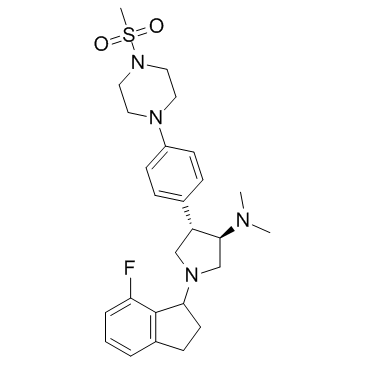
A-395 is a novel antagonist of Polycomb repressive complex 2 (PRC2) protein–protein interactions that potently inhibits the trimeric PRC2 complex (EZH2–EED–SUZ12) with an IC50 of 18 nM.
|
| Related Catalog |
|
| Target |
IC50: 18 nM (Trimeric PRC2 complex)[1]
|
| In Vitro |
The embryonic ectoderm development (EED) protein is an essential subunit of Polycomb repressive complex 2 (PRC2). A-395 antagonizes of the H3K27me3 binding functions of EED. A-395 binds to EED in the H3K27me3-binding pocket, thereby preventing allosteric activation of the catalytic activity of PRC2. A-395 is capable of competing for H3K27me3 peptide binding to EED, with an IC50 of 7 nM. A-395, but not the close chemical analog A-395N, modulates activity of PRC2 in cells by potently reducing the H3K27 methyl mark in a highly selective manner. A-395 treatment inhibits both H3K27me2 and H3K27me3, with IC50 values of 390 nM and 90 nM, respectively. Furthermore, A-395 treatment results in growth inhibition of human tumor cell lines sensitive to SAM-competitive EZH2 inhibitors[1].
|
| In Vivo |
The embryonic ectoderm development (EED) protein is an essential subunit of Polycomb repressive complex 2 (PRC2). A-395 antagonizes of the H3K27me3 binding functions of EED. A-395 binds to EED in the H3K27me3-binding pocket, thereby preventing allosteric activation of the catalytic activity of PRC2. A-395 is capable of competing for H3K27me3 peptide binding to EED, with an IC50 of 7 nM. A-395, but not the close chemical analog A-395N, modulates activity of PRC2 in cells by potently reducing the H3K27 methyl mark in a highly selective manner. A-395 treatment inhibits both H3K27me2 and H3K27me3, with IC50 values of 390 nM and 90 nM, respectively. Furthermore, A-395 treatment results in growth inhibition of human tumor cell lines sensitive to SAM-competitive EZH2 inhibitors[1].
|
| Kinase Assay |
The embryonic ectoderm development (EED) protein is an essential subunit of Polycomb repressive complex 2 (PRC2). A-395 antagonizes of the H3K27me3 binding functions of EED. A-395 binds to EED in the H3K27me3-binding pocket, thereby preventing allosteric activation of the catalytic activity of PRC2. A-395 is capable of competing for H3K27me3 peptide binding to EED, with an IC50 of 7 nM. A-395, but not the close chemical analog A-395N, modulates activity of PRC2 in cells by potently reducing the H3K27 methyl mark in a highly selective manner. A-395 treatment inhibits both H3K27me2 and H3K27me3, with IC50 values of 390 nM and 90 nM, respectively. Furthermore, A-395 treatment results in growth inhibition of human tumor cell lines sensitive to SAM-competitive EZH2 inhibitors[1].
|
| Cell Assay |
1,000 multiple myeloma cells are seeded in each well of 96-well cell culture plates and treated with A-395 (0.001-100 μM) or DMSO control for 10 d before the cell proliferation assay. Cell proliferation assays are conducted with the CellTiter-Glo Luminescent Cell Viability Assay[1].
|
| Animal Admin |
Mice[1] SCID mice are inoculated with the human Pfeiffer cell line and these xenografts are grown to size match at ∼200 mm3. Mice are subsequently treated with vehicle control, A-395 and A-395N at 300 mg/kg s.c. two times per week for 5 weeks or GSK126 at 50 mg/kg i.p. once per day for 36 d. Tumor volume is measured at different intervals and is represented by the average ± s.d. (eight mice per group)[1].
|
| References |
[1]. He Y, et al. The EED protein-protein interaction inhibitor A-395 inactivates the PRC2 complex. Nat Chem Biol. 2017 Apr;13(4):389-395.
|