Etofibrate
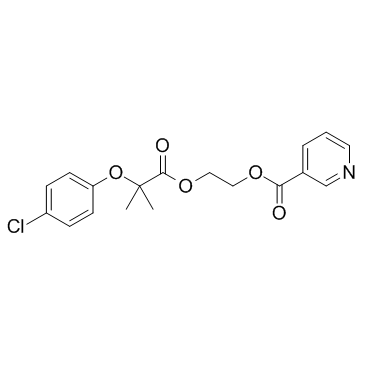
Etofibrate structure
|
Common Name | Etofibrate | ||
|---|---|---|---|---|
| CAS Number | 31637-97-5 | Molecular Weight | 363.792 | |
| Density | 1.3±0.1 g/cm3 | Boiling Point | 486.8±35.0 °C at 760 mmHg | |
| Molecular Formula | C18H18ClNO5 | Melting Point | 42-44ºC | |
| MSDS | Chinese USA | Flash Point | 248.2±25.9 °C | |
Use of EtofibrateEtofibrate is the ethandiol-1,2 diester of the nicotinic and clofibric acids. Etofibrate has been shown to be a potent hypolipidemic agent in animal and human. |
This table lists Chinese names, IUPAC names and various aliases of this chemical substance.
| Name | 2-[2-(4-chlorophenoxy)-2-methylpropanoyl]oxyethyl pyridine-3-carboxylate |
|---|---|
| Synonym | More Synonyms |
This table contains bioactivity, target information and biological‑assay experimental data of this compound.
| Description | Etofibrate is the ethandiol-1,2 diester of the nicotinic and clofibric acids. Etofibrate has been shown to be a potent hypolipidemic agent in animal and human. |
|---|---|
| Related Catalog | |
| In Vivo | Etofibrate is the ethandiol-1,2 diester of the nicotinic and clofibric acids. Etofibrate has been shown to be a potent hypolipidemic agent in animal and human. After 10 days of treatment with Etofibrate, the rats show a body weight similar to that found in the control animals but their liver weight is significantly enhanced whereas plasma cholesterol and triacylglycerol levels are decreased. Etofibrate treatment increases the bile flow of the animals, the effect being especially manifest during the first 2 hr after interruption of the enterohepatic circulation and the difference with the controls becomes statistically significant at 30 and 90 min. The cumulative amount of bile secreted plotted against time shows a highly significant linear correlation for both control and Etofibrate treated rats, the slope being significantly higher for the Etofibrate group than for controls[1]. |
| Animal Admin | Male Sprague Dawley rats weighing 200 to 220 g, fed ad libitum a standard laboratory diet and subjected to a 12 hr on-off light cycle and 22 to 24°C are used. Food is removed from the cages at the onset of the light cycle (7.00 a.m.) and 3 hr later, Etofibrate is administered by stomach tube without anesthesia at a dose of 300 mg/kg body weight/day to one group of animals whereas another, control, group is treated with the medium. After treatments, rats are again allowed free access to food. On the 10th day, the animals are treated as above, but 2 hr after receiving the Etofibrate or the medium the rats are anesthetized with an intraperitoneal injection (0.30 mL/100 g body weight). Animals are maintained at 37°C in a thermostatically controlled cabinet[1]. |
| References |
This table shows physicochemical parameters including melting point, boiling point, density, solubility and optical rotation. Missing data is marked as N/A.
| Density | 1.3±0.1 g/cm3 |
|---|---|
| Boiling Point | 486.8±35.0 °C at 760 mmHg |
| Melting Point | 42-44ºC |
| Molecular Formula | C18H18ClNO5 |
| Molecular Weight | 363.792 |
| Flash Point | 248.2±25.9 °C |
| Exact Mass | 363.087341 |
| PSA | 74.72000 |
| LogP | 3.15 |
| Vapour Pressure | 0.0±1.2 mmHg at 25°C |
| Index of Refraction | 1.555 |
| InChIKey | XXRVYAFBUDSLJX-UHFFFAOYSA-N |
| SMILES | CC(C)(Oc1ccc(Cl)cc1)C(=O)OCCOC(=O)c1cccnc1 |
| Storage condition | Refrigerator |
This table covers safety warnings, protective measures, incompatible substances and disposal guidelines for this compound.
| RIDADR | NONH for all modes of transport |
|---|---|
| HS Code | 2942000000 |
This table lists upstream starting materials and downstream derivative products related to this chemical.
| Precursor 0 | |
|---|---|
| DownStream 5 | |
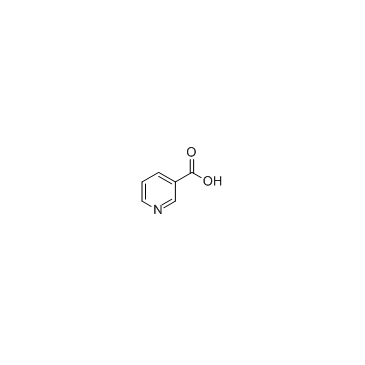 CAS#:59-67-6
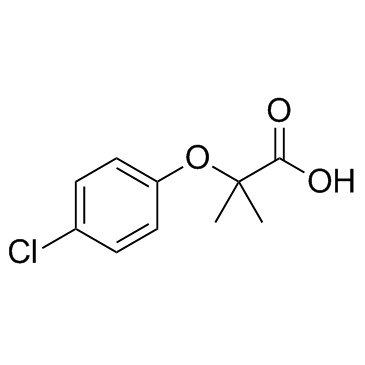 CAS#:882-09-7
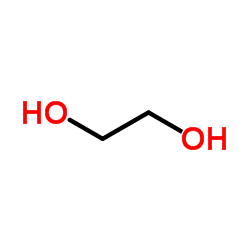 CAS#:107-21-1
 CAS#:3612-80-4
 CAS#:31637-96-4
This table shows customs‑related data including HS‑code, tariff and regulatory conditions for import and export.
| HS Code | 2933399090 |
|---|---|
| Summary | 2933399090. other compounds containing an unfused pyridine ring (whether or not hydrogenated) in the structure. VAT:17.0%. Tax rebate rate:13.0%. . MFN tariff:6.5%. General tariff:20.0% |
This table contains target information, in‑vitro & in‑vivo assay data for this compound.
This table collects all English aliases, systematic names and CAS‑related synonyms of the compound.
| 1-[2-(4-chloro-phenoxy)-2-methyl-propionyloxy]-2-nicotinoyloxy-ethane |
| glycol 2-(p-chlorophenoxy)-2-methylpropionate nicotinate |
| 2-{[2-(4-Chlorophenoxy)-2-methylpropanoyl]oxy}ethyl nicotinate |
| 2-{[2-(4-chlorophenoxy)-2-methylpropanoyl]oxy}ethyl pyridine-3-carboxylate |
| 3-Pyridinecarboxylic acid, 2-[2-(4-chlorophenoxy)-2-methyl-1-oxopropoxy]ethyl ester |
| EINECS 250-743-1 |
| Etofibrate |
| Etofibratum [INN-Latin] |
| Etofibrate (INN) |
| a-[(p-Chlorophenoxy)isobutyroyl]-b-(nicotinoyl)glycol |
| Ethofibrate |
| Ethylene Glycol 1-[2-(p-Chlorophenoxy)-2-methylpropionate]-2-nicotinate |
| Etofibrato [INN-Spanish] |
| Tricerol |
| Nicotinic Acid 2-Hydroxyethyl Ester 2-(p-Chlorophenoxy)-2-methylpropionate (Ester) |
| 3-Pyridinecarboxylic Acid 2-[2-(4-Chlorophenoxy)-2-methyl-1-oxopropoxy]ethyl Ester |
| Lipo-Merz |
This section contains frequently‑asked‑questions about this compound, including basic parameters, properties, storage conditions and corresponding answers.
| Q: What is the CAS number of 2-[2-(4-chlorophenoxy)-2-methylpropanoyl]oxyethyl pyridine-3-carboxylate? |
| A: CAS number of 2-[2-(4-chlorophenoxy)-2-methylpropanoyl]oxyethyl pyridine-3-carboxylate is 31637-97-5. |
| Q: What are the downstream products of 2-[2-(4-chlorophenoxy)-2-methylpropanoyl]oxyethyl pyridine-3-carboxylate? |
| A: Related downstream products(CAS) of 2-[2-(4-chlorophenoxy)-2-methylpropanoyl]oxyethyl pyridine-3-carboxylate: 59-67-6;882-09-7;107-21-1;3612-80-4;31637-96-4. |
| Q: What is the melting point of 2-[2-(4-chlorophenoxy)-2-methylpropanoyl]oxyethyl pyridine-3-carboxylate? |
| A: Melting point of 2-[2-(4-chlorophenoxy)-2-methylpropanoyl]oxyethyl pyridine-3-carboxylate is 42-44ºC. |
| Q: What is the polar surface area (PSA) of 2-[2-(4-chlorophenoxy)-2-methylpropanoyl]oxyethyl pyridine-3-carboxylate? |
| A: Polar surface area (PSA) of 2-[2-(4-chlorophenoxy)-2-methylpropanoyl]oxyethyl pyridine-3-carboxylate is 74.72000. |
| Q: What is the molecular formula of 2-[2-(4-chlorophenoxy)-2-methylpropanoyl]oxyethyl pyridine-3-carboxylate? |
| A: Molecular formula of 2-[2-(4-chlorophenoxy)-2-methylpropanoyl]oxyethyl pyridine-3-carboxylate is C18H18ClNO5. |
| Q: What is the InChIKey of 2-[2-(4-chlorophenoxy)-2-methylpropanoyl]oxyethyl pyridine-3-carboxylate? |
| A: InChIKey of 2-[2-(4-chlorophenoxy)-2-methylpropanoyl]oxyethyl pyridine-3-carboxylate is XXRVYAFBUDSLJX-UHFFFAOYSA-N. |
| Q: What are the uses of 2-[2-(4-chlorophenoxy)-2-methylpropanoyl]oxyethyl pyridine-3-carboxylate? |
| A: Main uses of 2-[2-(4-chlorophenoxy)-2-methylpropanoyl]oxyethyl pyridine-3-carboxylate: Etofibrate is the ethandiol-1,2 diester of the nicotinic and clofibric acids. Etofibrate has been shown to be a potent hypolipidemic agent in animal and human. |
| Q: What is the molecular weight of 2-[2-(4-chlorophenoxy)-2-methylpropanoyl]oxyethyl pyridine-3-carboxylate? |
| A: Molecular weight of 2-[2-(4-chlorophenoxy)-2-methylpropanoyl]oxyethyl pyridine-3-carboxylate is 363.792. |
| Q: What is the SMILES notation of 2-[2-(4-chlorophenoxy)-2-methylpropanoyl]oxyethyl pyridine-3-carboxylate? |
| A: SMILES notation of 2-[2-(4-chlorophenoxy)-2-methylpropanoyl]oxyethyl pyridine-3-carboxylate is CC(C)(Oc1ccc(Cl)cc1)C(=O)OCCOC(=O)c1cccnc1. |
| Q: What is the English name of 2-[2-(4-chlorophenoxy)-2-methylpropanoyl]oxyethyl pyridine-3-carboxylate? |
| A: The English name of 2-[2-(4-chlorophenoxy)-2-methylpropanoyl]oxyethyl pyridine-3-carboxylate is 2-[2-(4-chlorophenoxy)-2-methylpropanoyl]oxyethyl pyridine-3-carboxylate. |
This table lists manufacturers and suppliers of this compound, including vendor names and product supply reference information.
| Shanghai Nianxing Industrial Co., Ltd |