Saracatinib
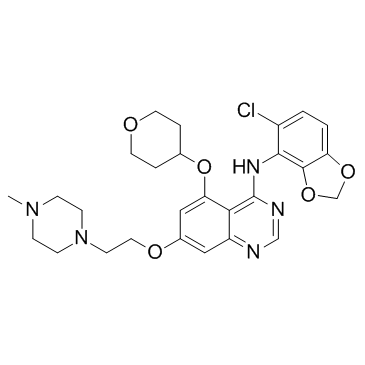
Saracatinib structure
|
Common Name | Saracatinib | ||
|---|---|---|---|---|
| CAS Number | 379231-04-6 | Molecular Weight | 542.026 | |
| Density | 1.3±0.1 g/cm3 | Boiling Point | 671.3±55.0 °C at 760 mmHg | |
| Molecular Formula | C27H32ClN5O5 | Melting Point | N/A | |
| MSDS | N/A | Flash Point | 359.8±31.5 °C | |
Use of SaracatinibSaracatinib (AZD0530) is a potent Src family inhibitor with IC50s of 2.7 to 11 nM for c-Src, Lck, c-YES, Lyn, Fyn, Fgr, and Blk and shows high selectivity over other tyrosine kinases. |
This table lists Chinese names, IUPAC names and various aliases of this chemical substance.
| Name | Saracatinib |
|---|---|
| Synonym | More Synonyms |
This table contains bioactivity, target information and biological‑assay experimental data of this compound.
| Description | Saracatinib (AZD0530) is a potent Src family inhibitor with IC50s of 2.7 to 11 nM for c-Src, Lck, c-YES, Lyn, Fyn, Fgr, and Blk and shows high selectivity over other tyrosine kinases. |
|---|---|
| Related Catalog | |
| Target |
IC50: 2.7 nM (Src), 30 nM (v-Abl), 66 nM (EGFR), 200 nM (c-Kit)[1] |
| In Vitro | Saracatinib (AZD0530), an orally available Src inhibitor, demonstrates potent antimigratory and anti-invasive effects in vitro, and inhibits metastasis in a murine model of bladder cancer. Antiproliferative activity of Saracatinib varies between cell lines (IC50 0.2-10 μM). Saracatinib potently inhibits the proliferation of Src3T3 mouse fibroblasts and demonstrates variable antiproliferative activity in a range of human cancer cell lines containing endogenous Src. Sub micromolar growth inhibition of five of the human cancer cell lines tested with Saracatinib (tumor types: colon, prostate, lung, and leukemia) is observed with IC50 values of 0.2-0.7 μM. In 3-day MTS cell proliferation assays, Saracatinib inhibits proliferation of the Bcr-Abl-driven human leukemia cell line K562 with an IC50 of 0.22 μM. In the microdroplet migration assay, Saracatinib reduces the migration of human lung cancer A549 cells in a concentration-dependent manner (IC50 0.14 μM)[1]. |
| In Vivo | Saracatinib (AZD0530) treatment potently inhibits the proliferation of subcutaneously transplanted Src3T3 fibroblasts in mice and rats in a dose-dependent manner. In both models, significant inhibition of tumor growth is seen at doses ≥6 mg/kg/day (60% inhibition in mice and 98% inhibition in rats versus animals treated with vehicle) and, at the maximum doses investigated, complete tumor growth inhibition is observed (100% inhibition at 25 mg/kg/day in mice and 10 mg/kg/day in rats)[1]. |
| Kinase Assay | Investigation of the reversibility and the mechanism of Saracatinib inhibition is conducted using a full-length activated human Src in a continuous, coupled assay. ATP and peptide substrate (Src II peptide) concentrations are varied in turn (ATP 40-1280 μM; Src II peptide 100-800 μM), in conjunction with Saracatinib (0-30 nM), at saturating concentrations of the non-varied substrate (ATP 1.6 mM; Src II peptide 1.0 mM). The binding affinity of Saracatinib for inactivated Src (phosphorylated at tyrosine 527, not tyrosine 416) is measured using a BIAcore inhibition-in-solution assay. The assay followed competition binding between Saracatinib and an immobilized ureidoquinazoline for binding to Src. Data analysis is performed by unweighted nonlinear regression using GraFit, version 5 and an F-test is used to identify the most suitable equation[1]. |
| Cell Assay | Cell proliferation is assessed using a colorimetric 5-bromo-2′-deoxyuridine (BrdU) Cell Proliferation ELISA kit. Briefly, cells are plated onto 96-well plates (1.5×10⁴ cells/well), the following day 0.039-20 μM Saracatinib in DMSO (at a final concentration of 0.5%) is added and the cells are incubated for 24 h. The cells are pulse labeled with BrdU for 2 h and fixed. Cellular DNA is then denatured with the provided solution and incubated with antiBrdU peroxidase for 90 min. Following three washes with phosphate-buffered saline, tetramethylbenzidine substrate solution is added and the plates are incubated on a plate shaker for 10-30 min until the positive control absorbance at 690 nm is approximately 1.5 absorbance units[1]. |
| Animal Admin | Mice and Rats[1] Female athymic mice (nu/nu) and rats (RH-rnu/rnu) are used. Animals are treated once daily by oral gavage with either vehicle alone or Saracatinib 6.25-50 mg/kg for 10-91 days. Tumor growth inhibition is calculated. For pharmacokinetic and pharmacodynamic analysis animals are humanely sacrificed and samples (plasma and tumor) are collected. Tumor samples are homogenized with 5 volumes of water and extracted with chloroform. Plasma and tumor samples are analyzed for Saracatinib concentration using high-performance liquid chromatography with tandem mass spectrometric detection after solid-phase extraction. |
| References |
This table shows physicochemical parameters including melting point, boiling point, density, solubility and optical rotation. Missing data is marked as N/A.
| Density | 1.3±0.1 g/cm3 |
|---|---|
| Boiling Point | 671.3±55.0 °C at 760 mmHg |
| Molecular Formula | C27H32ClN5O5 |
| Molecular Weight | 542.026 |
| Flash Point | 359.8±31.5 °C |
| Exact Mass | 541.209167 |
| PSA | 90.44000 |
| LogP | 2.74 |
| Vapour Pressure | 0.0±2.1 mmHg at 25°C |
| Index of Refraction | 1.641 |
| InChIKey | OUKYUETWWIPKQR-UHFFFAOYSA-N |
| SMILES | CN1CCN(CCOc2cc(OC3CCOCC3)c3c(Nc4c(Cl)ccc5c4OCO5)ncnc3c2)CC1 |
| Storage condition | -20℃ |
This table contains target information, in‑vitro & in‑vivo assay data for this compound.
This table collects all English aliases, systematic names and CAS‑related synonyms of the compound.
| N-(5-Chloro-1,3-benzodioxol-4-yl)-7-[2-(4-methyl-1-piperazinyl)ethoxy]-5-(tetrahydro-2H-pyran-4-yloxy)-4-quinazolinamine |
| AZD0530 difuMarate |
| N-(5-Chloro-1,3-benzodioxol-4-yl)-7-(2-(4-methylpiperazin-1-yl)ethoxy)-5-(tetrahydro-2H-pyran-4-yloxy)quinazolin-4-amine |
| N-(5-Chloro-1,3-benzodioxol-4-yl)-7-[2-(4-methylpiperazin-1-yl)ethoxy]-5-(tetrahydro-2H-pyran-4-yloxy)quinazolin-4-amine |
| Saracatinib |
| AZD0530 |
This section contains frequently‑asked‑questions about this compound, including basic parameters, properties, storage conditions and corresponding answers.
| Q: What is the boiling point of Saracatinib? |
| A: Boiling point of Saracatinib is 671.3±55.0 °C at 760 mmHg. |
| Q: What is the English name of Saracatinib? |
| A: The English name of Saracatinib is Saracatinib. |
| Q: What is the molecular weight of Saracatinib? |
| A: Molecular weight of Saracatinib is 542.026. |
| Q: What are the storage conditions for Saracatinib? |
| A: Storage conditions for Saracatinib: -20℃. |
| Q: What is the CAS number of Saracatinib? |
| A: CAS number of Saracatinib is 379231-04-6. |
| Q: What are the uses of Saracatinib? |
| A: Main uses of Saracatinib: Saracatinib (AZD0530) is a potent Src family inhibitor with IC50s of 2.7 to 11 nM for c-Src, Lck, c-YES, Lyn, Fyn, Fgr, and Blk and shows high selectivity over other tyrosine kinases. |
| Q: What is the InChIKey of Saracatinib? |
| A: InChIKey of Saracatinib is OUKYUETWWIPKQR-UHFFFAOYSA-N. |
| Q: What is the SMILES notation of Saracatinib? |
| A: SMILES notation of Saracatinib is CN1CCN(CCOc2cc(OC3CCOCC3)c3c(Nc4c(Cl)ccc5c4OCO5)ncnc3c2)CC1. |
| Q: What is the polar surface area (PSA) of Saracatinib? |
| A: Polar surface area (PSA) of Saracatinib is 90.44000. |
| Q: What English synonyms does Saracatinib have? |
| A: English synonyms of Saracatinib: N-(5-Chloro-1,3-benzodioxol-4-yl)-7-[2-(4-methyl-1-piperazinyl)ethoxy]-5-(tetrahydro-2H-pyran-4-yloxy)-4-quinazolinamine, AZD0530 difuMarate, N-(5-Chloro-1,3-benzodioxol-4-yl)-7-(2-(4-methylpiperazin-1-yl)ethoxy)-5-(tetrahydro-2H-pyran-4-yloxy)quinazolin-4-amine, N-(5-Chloro-1,3-benzodioxol-4-yl)-7-[2-(4-methylpiperazin-1-yl)ethoxy]-5-(tetrahydro-2H-pyran-4-yloxy)quinazolin-4-amine, Saracatinib, AZD0530. |
This table lists manufacturers and suppliers of this compound, including vendor names and product supply reference information.
| Shanghai Nianxing Industrial Co., Ltd |
| Dayang Chem (Hangzhou) Co., Ltd. |