Quizartinib (AC220)
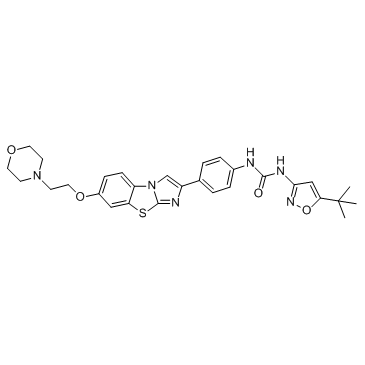
Quizartinib (AC220) structure
|
Common Name | Quizartinib (AC220) | ||
|---|---|---|---|---|
| CAS Number | 950769-58-1 | Molecular Weight | 560.667 | |
| Density | 1.4±0.1 g/cm3 | Boiling Point | N/A | |
| Molecular Formula | C29H32N6O4S | Melting Point | N/A | |
| MSDS | N/A | Flash Point | N/A | |
Use of Quizartinib (AC220)Quizartinib (AC220) is a potent Flt3 tyrosine kinase inhibitor with a Kd of 1.6±0.7 nM. |
This table lists Chinese names, IUPAC names and various aliases of this chemical substance.
| Name | 1-(5-tert-butyl-1,2-oxazol-3-yl)-3-[4-[6-(2-morpholin-4-ylethoxy)imidazo[2,1-b][1,3]benzothiazol-2-yl]phenyl]urea |
|---|---|
| Synonym | More Synonyms |
This table contains bioactivity, target information and biological‑assay experimental data of this compound.
| Description | Quizartinib (AC220) is a potent Flt3 tyrosine kinase inhibitor with a Kd of 1.6±0.7 nM. |
|---|---|
| Related Catalog | |
| Target |
Kd: 1.6±0.7 nM (Flt3)[1] |
| In Vitro | Quizartinib (AC220) is a novel compound expressly optimized as a FLT3 inhibitor for the treatment of acute myeloid leukemia (AML). Quizartinib inhibits FLT3-WT and FLT3-ITD autophosphorylation with IC50 of 4.2±0.3 nM and 1.1±0.1 nM, respectively. Quizartinib inhibits MV4-11 and A375 cells with IC50 of 0.56±0.3 nM and >10 000 nM, respectively. Quizartinib inhibits FLT3 with low nanomolar potency in cellular assays and is highly selective when screened against the majority of the human protein kinome[1]. |
| In Vivo | Quizartinib (AC220) inhibits FLT3 activity in vivo, significantly extends survival in a mouse model of FLT3-ITD AML at doses as low as 1 mg/kg when dosed orally once a day, eradicates tumors in a FLT3-dependent mouse xenograft model at 10 mg/kg, and potently inhibits FLT3 activity in primary patient cells. The oral bioavailability of Quizartinib, determined in rats by comparing oral and intravenous pharmacokinetics at 3 mg/kg, is approximately 40%. A single 10 mg/kg dose of Quizartinib is administered by oral gavage, and mice are killed at 2 time points after dosing, using groups of 4 animals each. Quantitation of total FLT3 and phospho-FLT3 in tumor samples revealed time-dependent inhibition of FLT3 autophosphorylation. FLT3 activity is inhibited by 90% at 2 hours, and 40% at 24 hours after administration. The extent of inhibition therefore correlated well with the expected free Quizartinib plasma levels, based on pharmacokinetic experiments[1]. |
| Kinase Assay | KinomeScan kinase binding assays are performed. For the FLT3 assay, a kinase construct that spanned the catalytic domain only (amino acids 592 to 969) is used. This construct does not include the juxtamembrane domain and is designed to measure the intrinsic binding affinity of the open FLT3 active site for inhibitors[1]. |
| Cell Assay | MV4-11 and RS4;11 cells are cultured in Iscove media with 10% fetal bovine serum (FBS) and RPMI complete with 10% FBS, respectively. For proliferation assays, cells are cultured overnight in low serum media (0.5% FBS), then seeded in a 96-well plate at 40 000 cells per well. Inhibitors (e.g., Quizartinib) are added to the cells and incubated at 37°C for 72 hours. Cell viability is measured using the Cell Titer-Blue Cell Viability Assay. To measure inhibition of FLT3 autophosphorylation, cells are cultured in low serum media (0.5% FBS) overnight and seeded at a density of 400 000 cells per well in a 96-well plate the following day. The cells are incubated with inhibitors (e.g., Quizartinib) for 2 hours at 37°C. To induce FLT3 autophosphorylation in RS4;11 cells, 100 ng/mL FLT3 ligand is added for 15 minutes after the 2-hour compound incubation. Cell lysates are prepared and incubated in 96-well plates precoated with a total FLT3 capture antibody. The coated plates are incubated with either a biotinylated antibody against FLT3 to detect total FLT3 or an antibody against phosphotyrosines to detect FLT3 autophosphorylation. In both cases, a SULFO-tagged streptavidin secondary antibody is used for electrochemiluminescence detection on the Meso Scale Discovery platform[1]. |
| Animal Admin | Mice[1] Female NU/NU or severe combined immunodeficient mice are used. Quizartinib (hydrochloride salt) is formulated in 22% hydroxypropyl-β-cyclodextrin, CEP-701 is formulated in 20% gelucire 44/14 in water (vol/vol), MLN-518 and sunitinib are formulated in 10 mM sodium citrate (pH 3.5), PKC-412 is formulated in 3:1 gelucire 44/14-propylene glycol (vol/vol), and sorafenib (toluene sulfonate salt) is formulated in 80% PEG-400. Compound concentrations are chosen to deliver the desired dose in a volume of 10 mL/kg. Compounds are administered by oral gavage and plasma samples collected 0.25, 0.5, 1, 2, 4, 6, and 24 hours after dosing. To collect plasma samples, eye bleeds (150 μL) are taken semilongitudinally using 3 groups of 3 animals each, taking 2 to 3 time points per animal to obtain a total of 3 independent plasma concentration time courses. Plasma samples and controls (25 μL) are extracted with 4 volumes of acetonitrile containing an internal standard and analyzed by liquid chromatography tandem mass spectrometry. |
| References |
This table shows physicochemical parameters including melting point, boiling point, density, solubility and optical rotation. Missing data is marked as N/A.
| Density | 1.4±0.1 g/cm3 |
|---|---|
| Molecular Formula | C29H32N6O4S |
| Molecular Weight | 560.667 |
| Exact Mass | 560.220581 |
| PSA | 134.40000 |
| LogP | 4.03 |
| Appearance of Characters | light yellow solid |
| Index of Refraction | 1.691 |
| InChIKey | CVWXJKQAOSCOAB-UHFFFAOYSA-N |
| SMILES | CC(C)(C)c1cc(NC(=O)Nc2ccc(-c3cn4c(n3)sc3cc(OCCN5CCOCC5)ccc34)cc2)no1 |
| Storage condition | -20℃ |
This table contains target information, in‑vitro & in‑vivo assay data for this compound.
|
Name: Binding affinity to EGFR G719S mutant
Source: ChEMBL
Target: Epidermal growth factor receptor
External Id: CHEMBL1244804
|
|
Name: Binding affinity to EGFR G719C mutant
Source: ChEMBL
Target: Epidermal growth factor receptor
External Id: CHEMBL1244803
|
|
Name: Binding affinity to EGFR E746-A750del mutant
Source: ChEMBL
Target: N/A
External Id: CHEMBL1244802
|
|
Name: Binding affinity to EGFR
Source: ChEMBL
Target: Epidermal growth factor receptor
External Id: CHEMBL1244801
|
|
Name: Primary qHTS assay for inhibitors of alpha-synuclein gene (SNCA) expression
Source: NCGC
External Id: SNCA-p-activity-luciferase
|
|
Name: Binding affinity to DYRK2
Source: ChEMBL
Target: Dual specificity tyrosine-phosphorylation-regulated kinase 2
External Id: CHEMBL1244800
|
|
Name: Binding affinity to DYRK1B
Source: ChEMBL
Target: Dual specificity tyrosine-phosphorylation-regulated kinase 1B
External Id: CHEMBL1244799
|
|
Name: Binding affinity to DYRK1A
Source: ChEMBL
Target: Dual specificity tyrosine-phosphorylation-regulated kinase 1A
External Id: CHEMBL1244798
|
|
Name: Binding affinity to DRAK2
Source: ChEMBL
Target: Serine/threonine-protein kinase 17B
External Id: CHEMBL1244797
|
|
Name: Human KIT proto-oncogene receptor tyrosine kinase (Type III RTKs: PDGFR, CSFR, Kit, F...
Source: IUPHAR-DB
Target: KIT proto-oncogene receptor tyrosine kinase (Type III RTKs: PDGFR, CSFR, Kit, FLT3 receptor family) [Homo sapiens]
External Id: 1805_Human
|
This table collects all English aliases, systematic names and CAS‑related synonyms of the compound.
| Quizartinib |
| AC-220 |
| 1-[5-(2-Methyl-2-propanyl)-1,2-oxazol-3-yl]-3-(4-{7-[2-(4-morpholinyl)ethoxy]imidazo[2,1-b][1,3]benzothiazol-2-yl}phenyl)urea |
| S1526_Selleck |
| AC220 |
This section contains frequently‑asked‑questions about this compound, including basic parameters, properties, storage conditions and corresponding answers.
| Q: What are the storage conditions for 1-(5-tert-butyl-1,2-oxazol-3-yl)-3-[4-[6-(2-morpholin-4-ylethoxy)imidazo[2,1-b][1,3]benzothiazol-2-yl]phenyl]urea? |
| A: Storage conditions for 1-(5-tert-butyl-1,2-oxazol-3-yl)-3-[4-[6-(2-morpholin-4-ylethoxy)imidazo[2,1-b][1,3]benzothiazol-2-yl]phenyl]urea: -20℃. |
| Q: What is the CAS number of 1-(5-tert-butyl-1,2-oxazol-3-yl)-3-[4-[6-(2-morpholin-4-ylethoxy)imidazo[2,1-b][1,3]benzothiazol-2-yl]phenyl]urea? |
| A: CAS number of 1-(5-tert-butyl-1,2-oxazol-3-yl)-3-[4-[6-(2-morpholin-4-ylethoxy)imidazo[2,1-b][1,3]benzothiazol-2-yl]phenyl]urea is 950769-58-1. |
| Q: What is the InChIKey of 1-(5-tert-butyl-1,2-oxazol-3-yl)-3-[4-[6-(2-morpholin-4-ylethoxy)imidazo[2,1-b][1,3]benzothiazol-2-yl]phenyl]urea? |
| A: InChIKey of 1-(5-tert-butyl-1,2-oxazol-3-yl)-3-[4-[6-(2-morpholin-4-ylethoxy)imidazo[2,1-b][1,3]benzothiazol-2-yl]phenyl]urea is CVWXJKQAOSCOAB-UHFFFAOYSA-N. |
| Q: What is the polar surface area (PSA) of 1-(5-tert-butyl-1,2-oxazol-3-yl)-3-[4-[6-(2-morpholin-4-ylethoxy)imidazo[2,1-b][1,3]benzothiazol-2-yl]phenyl]urea? |
| A: Polar surface area (PSA) of 1-(5-tert-butyl-1,2-oxazol-3-yl)-3-[4-[6-(2-morpholin-4-ylethoxy)imidazo[2,1-b][1,3]benzothiazol-2-yl]phenyl]urea is 134.40000. |
| Q: What is the physical appearance of 1-(5-tert-butyl-1,2-oxazol-3-yl)-3-[4-[6-(2-morpholin-4-ylethoxy)imidazo[2,1-b][1,3]benzothiazol-2-yl]phenyl]urea? |
| A: 1-(5-tert-butyl-1,2-oxazol-3-yl)-3-[4-[6-(2-morpholin-4-ylethoxy)imidazo[2,1-b][1,3]benzothiazol-2-yl]phenyl]urea appears as light yellow solid. |
| Q: What English synonyms does 1-(5-tert-butyl-1,2-oxazol-3-yl)-3-[4-[6-(2-morpholin-4-ylethoxy)imidazo[2,1-b][1,3]benzothiazol-2-yl]phenyl]urea have? |
| A: English synonyms of 1-(5-tert-butyl-1,2-oxazol-3-yl)-3-[4-[6-(2-morpholin-4-ylethoxy)imidazo[2,1-b][1,3]benzothiazol-2-yl]phenyl]urea: Quizartinib, AC-220, 1-[5-(2-Methyl-2-propanyl)-1,2-oxazol-3-yl]-3-(4-{7-[2-(4-morpholinyl)ethoxy]imidazo[2,1-b][1,3]benzothiazol-2-yl}phenyl)urea, S1526_Selleck, AC220. |
| Q: What is the molecular weight of 1-(5-tert-butyl-1,2-oxazol-3-yl)-3-[4-[6-(2-morpholin-4-ylethoxy)imidazo[2,1-b][1,3]benzothiazol-2-yl]phenyl]urea? |
| A: Molecular weight of 1-(5-tert-butyl-1,2-oxazol-3-yl)-3-[4-[6-(2-morpholin-4-ylethoxy)imidazo[2,1-b][1,3]benzothiazol-2-yl]phenyl]urea is 560.667. |
| Q: What is the English name of 1-(5-tert-butyl-1,2-oxazol-3-yl)-3-[4-[6-(2-morpholin-4-ylethoxy)imidazo[2,1-b][1,3]benzothiazol-2-yl]phenyl]urea? |
| A: The English name of 1-(5-tert-butyl-1,2-oxazol-3-yl)-3-[4-[6-(2-morpholin-4-ylethoxy)imidazo[2,1-b][1,3]benzothiazol-2-yl]phenyl]urea is 1-(5-tert-butyl-1,2-oxazol-3-yl)-3-[4-[6-(2-morpholin-4-ylethoxy)imidazo[2,1-b][1,3]benzothiazol-2-yl]phenyl]urea. |
| Q: What are the uses of 1-(5-tert-butyl-1,2-oxazol-3-yl)-3-[4-[6-(2-morpholin-4-ylethoxy)imidazo[2,1-b][1,3]benzothiazol-2-yl]phenyl]urea? |
| A: Main uses of 1-(5-tert-butyl-1,2-oxazol-3-yl)-3-[4-[6-(2-morpholin-4-ylethoxy)imidazo[2,1-b][1,3]benzothiazol-2-yl]phenyl]urea: Quizartinib (AC220) is a potent Flt3 tyrosine kinase inhibitor with a Kd of 1.6±0.7 nM. |
| Q: What is the molecular formula of 1-(5-tert-butyl-1,2-oxazol-3-yl)-3-[4-[6-(2-morpholin-4-ylethoxy)imidazo[2,1-b][1,3]benzothiazol-2-yl]phenyl]urea? |
| A: Molecular formula of 1-(5-tert-butyl-1,2-oxazol-3-yl)-3-[4-[6-(2-morpholin-4-ylethoxy)imidazo[2,1-b][1,3]benzothiazol-2-yl]phenyl]urea is C29H32N6O4S. |
This table lists manufacturers and suppliers of this compound, including vendor names and product supply reference information.
| Shanghai Nianxing Industrial Co., Ltd |