Modulating effects in human diets of dietary fibre and beef, and of time and dose on the reactive microcapsule trapping of benzo[a]pyrene metabolites in the rat gastrointestinal tract.
I K O'Neill, S Bingham, A C Povey, I Brouet, J C Bereziat
Index: Carcinogenesis 11(4) , 599-607, (1990)
Full Text: HTML
Abstract
Trapping by magnetic polyethyleneimine (PEI) microcapsules was utilized to investigate the influence in male rats of dose, human dietary composition and time-dependence on reactive metabolites of benzo[a]pyrene (B[a]P) in the gastrointestinal (GI) tract; also, PEI microcapsules modified with copper phthalocyanine tetrasulphonic acid (CPTS) were tested in vivo for trapping of endogenous mutagens having planar molecular structure. In a preliminary experiment the PEI microcapsules were administered by gavage at 0, 24 and 48 h, with [14C]B[a]P at 2 h to chow-fed BDVI rats; microcapsules were recovered from faeces collected at 24, 48 and 72 h, and then subjected to an extraction sequence showing that the trapped B[a]P metabolites were inconsistent with B[a]P diol epoxide trapping (as previously found) and unaltered by elapsed time or 5-fold dose alteration of B[a]P. Then five groups of F344 rats were fed isocalorically either one of four low-fat human diets or rat chow; in order to investigate influences of diet both on B[a]P and endogenous mutagens, half of each group was tested at 2 weeks with this PEI microcapsule/[14C]B[a]P protocol and then at 3 weeks, PEI-CPTS microcapsules (two gavages). So as to provide a cross-over comparison, the other half of each group was first tested with PEI-CPTS microcapsules followed by PEI microcapsules/[14C]B[a]P 1 week later. The human diets were prepared from cooked British foods so as to simulate the adequate intake of all nutrients required by humans; but with 3-fold differences in intake levels of beef and dietary fibre non-starch polysaccharide (NSP), while ensuring the same intake of available energy, protein, fat and calcium. They gave very similar body-weight gains in the four groups but greatly reduced faecal weight, protein and total faecal enzyme activity compared with chow; the extraction pattern of microcapsule-trapped B[a]P metabolite radioactivity was not significantly altered. However, human diet consumption caused a 2- to 6-fold increase in B[a]P metabolite binding to microcapsules and reductions in microcapsule recovery, net 70-h B[a]P excretion, faecal protein and total activities for beta-glucuronidase and beta-galactosidase; these effects were more pronounced after 3 weeks, presumably due to prolonged dietary adaptation. Increased NSP in human diets significantly increased the B[a]P metabolite excretion and marginally reduced the microcapsule binding. The increase in microcapsule binding of B[a]P metabolites, interpreted as reflecting an increased amount of reactive metabolites encountered, was related to the dietary intake weight ratio of beef/NSP.(ABSTRACT TRUNCATED AT 400 WORDS)
Related Compounds
| Structure | Name/CAS No. | Molecular Formula | Articles |
|---|---|---|---|
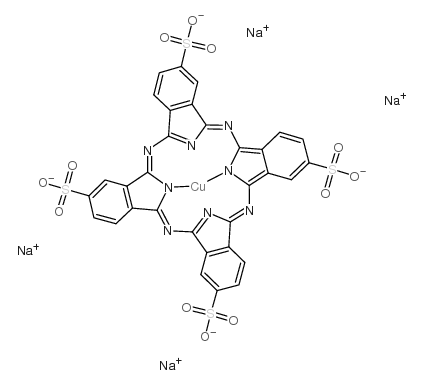 |
copper phthalocyanine tetrasulfonic acid tetrasodium salt
CAS:27360-85-6 |
C32H12CuN8Na4O12S4 |
|
Short-term in vivo evaluation of novel vital dyes for intrao...
2006-01-01 [Retina (Philadelphia, Pa.) 26(6) , 673-8, (2006)] |
|
Administration of novel dyes for intraocular surgery: an in ...
2006-08-01 [Invest. Ophthalmol. Vis. Sci. 47(8) , 3573-8, (2006)] |
|
Cellulose bearing covalently linked copper phthalocyanine tr...
[J. Chromatogr. A. 597(1-2) , 37-56, (1992)] |
|
Preferential uptake of a water-soluble phthalocyanine by ath...
1990-10-01 [Atherosclerosis 84(2-3) , 135-9, (1990)] |
|
A high-affinity protein stain for western blots, tissue prin...
1992-05-15 [Anal. Biochem. 203(1) , 109-15, (1992)] |