Comparison of the protective effect amongst anticholinergic drugs on methacholine-induced bronchoconstriction in asthma.
Bruno Sposato, Sposato Bruno, Roberta Barzan, Barzan Roberta, Antonio Calabrese, Calabrese Antonio, Clemente Franco, Franco Clemente
Index: J. Asthma 45(5) , 397-401, (2008)
Full Text: HTML
Abstract
The protective effect of inhaled anticholinergic drugs in the methacholine-induced bronchospasm is well-known. The objective of this study was to assess if any possible differences may be found among Ipratropium (IB), Oxitropium (OXI) and Tiotropium (TIO) pre-treatments to obtain the protective effect. Forty-four patients with intermittent bronchial asthma and PD(20)FEV(1) < 200 microg were selected (24 M, 20 F; mean age 32 +/- 8.8). On the baseline, they had mean FEV(1)%: 98.8 +/- 8.54 of theoretical and mean PD(15)FEV(1) 111.8 +/- 61.04 microg. After 72 hours, all patients underwent a second methacholine challenge and were given Ipratropium (40 microg by MDI in 14 pts) or Oxitropium (200 microg by MDI in 14 pts) or Tiotropium (18 microg by Handihaler in 16 pts) sixty minutes before the test. Sixty minutes after the bronchodilator inhalation, the FEV(1)% increase was higher (p < 0.05) in OXI (6.7 +/- 4.83%) and TIO groups (6.11 +/- 2.54%) than in the IB group (3.8 +/- 1.96%). In the IB group PD(15)FEV(1) and PD(20)FEV(1) were obtained in all patients, while in the OXI group they were obtained in 12 and 5 pts respectively and in the TIO group in 14 and 5 pts respectively. Normal hyperreactivity was obtained in 2 patients, in both OXI and TIO groups. In OXI and TIO, the PD(15) obtained after drug pre-medication, was similar (respectively 1628 +/- 955.7 and 1595.5 +/- 990 microg), but higher (p < 0.0001) in comparison to the PD(15) measured in the IB group (532.2 +/- 434.8 microg). Also, the dose-response slope (decline percentage of FEV(1)/cumulative methacholine dose) after PD(15) was similar in both OXI and TIO groups but different in the IB group. A significant relationship (p < 0.01) was found between PD(15)FEV(1) (obtained in 40 pts) and the increase in FEV(1)% obtained 60 minutes after bronchodilator inhalations (r = 0.53). In conclusion, with a standard dose, both Oxitropium and Tiotropium seem to have the same protective effect in bronchial asthma but higher than Ipratropium. It's probable that the best dose of Ipratropium should be a higher one than the usual dose taken.
Related Compounds
| Structure | Name/CAS No. | Molecular Formula | Articles |
|---|---|---|---|
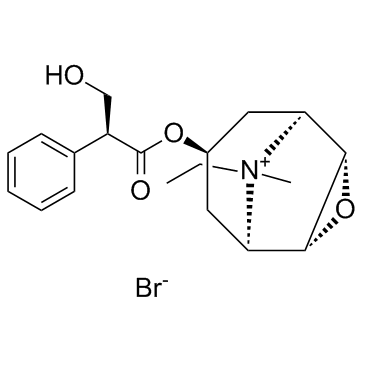 |
Oxitropium Bromide
CAS:30286-75-0 |
C19H26BrNO4 |
|
The development of anticholinergics in the management of COP...
2007-01-01 [Int. J. Chron. Obstruct. Pulmon. Dis. 2(1) , 33-40, (2007)] |
|
Anticholinergic therapy for acute asthma in children.
2012-01-01 [Cochrane Database Syst. Rev. 4 , CD003797, (2012)] |
|
Effect of resection of the posterior nasal nerve on function...
2008-01-01 [Acta Otolaryngol. 128(12) , 1337-41, (2008)] |
|
Effects of replacing oxitropium with tiotropium on pulmonary...
2007-03-01 [Respir. Med. 101(3) , 476-80, (2007)] |
|
High-resolution computed tomography evaluation of airway dis...
2008-02-01 [Radiol. Med. 113(1) , 43-55, (2008)] |