Rapid loss of blood-brain barrier P-glycoprotein activity through transporter internalization demonstrated using a novel in situ proteolysis protection assay.
Brian T Hawkins, Robert R Rigor, David S Miller
Index: J. Cereb. Blood Flow Metab. 30(9) , 1593-7, (2010)
Full Text: HTML
Abstract
Blood-brain barrier (BBB) P-glycoprotein activity is rapidly reduced by vascular endothelial growth factor (VEGF) acting via Src and by tumor necrosis factor-alpha acting via protein kinase C (PKC)beta1. To probe underlying mechanism(s), we developed an in vivo, immunoblot-based proteinase K (PK) protection assay to assess the changes in the P-glycoprotein content of the BBB's luminal membrane. Infusion of PK into the brain vasculature selectively cleaved luminal membrane P-glycoprotein, leaving intracellular proteins intact. Intracerebroventricular injection of VEGF partially protected P-glycoprotein from proteolytic cleavage, consistent with transporter internalization. Activation of PKCbeta1 did not protect P-glycoprotein. Thus, VEGF and PKCbeta1 reduce P-glycoprotein activity by distinct mechanisms.
Related Compounds
| Structure | Name/CAS No. | Molecular Formula | Articles |
|---|---|---|---|
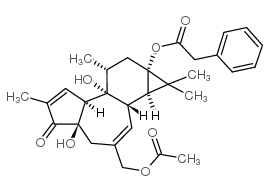 |
12-deoxyphorbol 13-phenylacetate 20-acetate
CAS:54662-30-5 |
C30H36O7 |
|
Phosphorylation of connexin43 and inhibition of gap junction...
2001-02-01 [Carcinogenesis 22(2) , 221-31, (2001)] |
|
Protein kinase C modulates insulin action in human skeletal ...
2000-03-01 [Am. J. Physiol. Endocrinol. Metab. 278(3) , E553-62, (2000)] |
|
Inhibition of erythema induced by pro-inflammatory esters of...
1981-01-01 [Acta Pharmacol. Toxicol. (Copenh.) 48(1) , 47-52, (1981)] |
|
Protein kinase Cdelta-dependent induction of manganese super...
1998-12-18 [J. Biol. Chem. 273(51) , 34639-45, (1998)] |
|
Activation of protein kinase C prevents induction of apoptos...
1997-05-16 [Int. J. Cancer 71(4) , 691-7, (1997)] |