Chelation in metal intoxication.
Swaran J S Flora, Vidhu Pachauri
Index: Int. J. Environ. Res. Public Health 7 , 2745, (2010)
Full Text: HTML
Abstract
Chelation therapy is the preferred medical treatment for reducing the toxic effects of metals. Chelating agents are capable of binding to toxic metal ions to form complex structures which are easily excreted from the body removing them from intracellular or extracellular spaces. 2,3-Dimercaprol has long been the mainstay of chelation therapy for lead or arsenic poisoning, however its serious side effects have led researchers to develop less toxic analogues. Hydrophilic chelators like meso-2,3-dimercaptosuccinic acid effectively promote renal metal excretion, but their ability to access intracellular metals is weak. Newer strategies to address these drawbacks like combination therapy (use of structurally different chelating agents) or co-administration of antioxidants have been reported recently. In this review we provide an update of the existing chelating agents and the various strategies available for the treatment of heavy metals and metalloid intoxications.
Related Compounds
| Structure | Name/CAS No. | Molecular Formula | Articles |
|---|---|---|---|
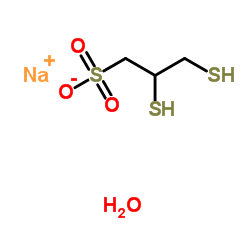 |
Sodium 2,3-dimercaptopropanesulfonate monohydrate
CAS:207233-91-8 |
C3H9NaO4S3 |
|
Identification and Characterization of EDTA Test Strip Inter...
2015-01-01 [Clin. Lab. 61 , 785-91, (2015)] |
|
Farnesylated and methylated KRAS4b: high yield production of...
2015-01-01 [Sci. Rep. 5 , 15916, (2015)] |
|
Interactions between phospholipids and titanium dioxide part...
2014-11-01 [Colloids Surf. B Biointerfaces 123 , 150-7, (2014)] |
|
Toxicological significance of renal Bcrp: Another potential ...
2015-06-01 [Toxicol. Appl. Pharmacol. 285 , 110-7, (2015)] |
|
Inhibitory mechanism of dimercaptopropanesulfonic acid (DMPS...
2014-11-01 [Biochimie 106 , 167-74, (2014)] |