Detection and quantification of unbound phytochelatin 2 in plant extracts of Brassica napus grown with different levels of mercury.
Santiago Iglesia-Turiño, Anna Febrero, Olga Jauregui, Cristina Caldelas, Jose Luis Araus, Jordi Bort
Index: Plant Physiol. 142 , 742, (2006)
Full Text: HTML
Abstract
The mercury (Hg) accumulation mechanism was studied in rape (Brassica napus) plants grown under a Hg concentration gradient (0 microm-1,000 microm). Hg mainly accumulated in roots. Therefore, the presence of phytochelatins (PCs) was studied in the roots of the plants. The high stability of the PC-Hg multicomplexes (mPC-nHg) seems to be the main reason for the lack of previous Hg-PC characterization studies. We propose a modification of the method to detect and quantify unbound PC of Hg in plant extracts via high-performance liquid chromatography coupled to electrospray tandem mass spectrometry and inductively coupled plasma mass spectrometry in parallel. We separated the PC from the Hg by adding the chelating agent sodium 2,3-dimercaptopropanesulfonate monohydrate. We only detected the presence of PC after the addition of the chelating agent. Some multicomplexes mPC-nHg could be formed but, due to their large sizes, could not be detected. In this study, only PC(2) was observed in plant samples. Hg accumulation was correlated with PC(2) concentration (r(2) = 0.98).
Related Compounds
| Structure | Name/CAS No. | Molecular Formula | Articles |
|---|---|---|---|
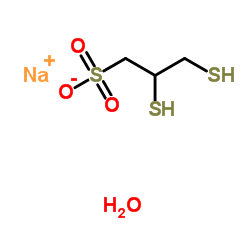 |
Sodium 2,3-dimercaptopropanesulfonate monohydrate
CAS:207233-91-8 |
C3H9NaO4S3 |
|
Identification and Characterization of EDTA Test Strip Inter...
2015-01-01 [Clin. Lab. 61 , 785-91, (2015)] |
|
Farnesylated and methylated KRAS4b: high yield production of...
2015-01-01 [Sci. Rep. 5 , 15916, (2015)] |
|
Interactions between phospholipids and titanium dioxide part...
2014-11-01 [Colloids Surf. B Biointerfaces 123 , 150-7, (2014)] |
|
Toxicological significance of renal Bcrp: Another potential ...
2015-06-01 [Toxicol. Appl. Pharmacol. 285 , 110-7, (2015)] |
|
Inhibitory mechanism of dimercaptopropanesulfonic acid (DMPS...
2014-11-01 [Biochimie 106 , 167-74, (2014)] |