Retinoids and human breast cancer: in vivo effects of an antagonist for RAR-alpha.
Salvatore Toma, Laura Emionite, Angelo Scaramuccia, Giambattista Ravera, Linda Scarabelli
Index: Cancer Lett. 219(1) , 27-31, (2005)
Full Text: HTML
Abstract
The aim of the present study was to evaluate the in vivo effects of the RAR-alpha selective antagonist Ro 41-5253 on a xenograft animal model for breast cancer. Our observations indicate a lack of toxic side effects of the drug, even when used at high dosages. It is interesting to note that using Ro 41-5253 at dosages of 10, 30 and 100 mg/kg/die resulted in a slight, but significant inhibition of cell growth. The data obtained in this study represents the basis for a further evaluation of Ro 41-5253 anti-neoplastic activity on transgenic breast cancer animal models.
Related Compounds
| Structure | Name/CAS No. | Molecular Formula | Articles |
|---|---|---|---|
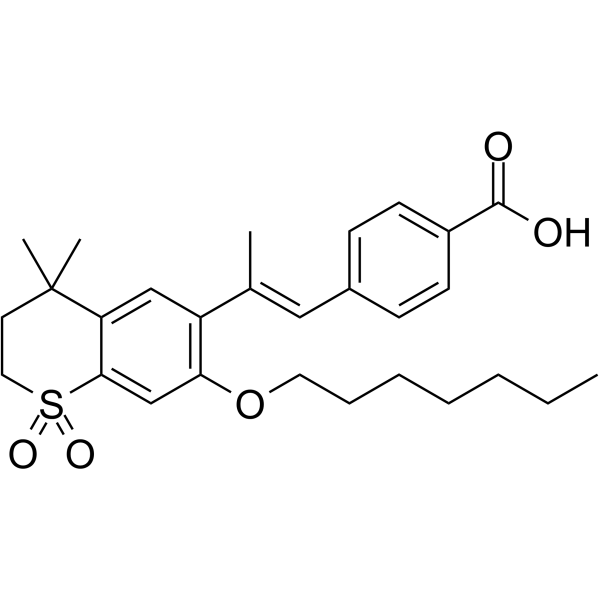 |
Ro 41-5253
CAS:144092-31-9 |
C28H36O5S |
|
Effect of all-trans-retinoic acid on enterovirus 71 infectio...
2014-05-01 [Br. J. Nutr. 111(9) , 1586-93, (2014)] |
|
Retinoic acid inhibits in vivo interleukin-2 gene expression...
2009-04-01 [Immunology 126(4) , 514-22, (2009)] |
|
Overexpression of mucin genes induced by interleukin-1 beta,...
2002-06-01 [Exp. Lung Res. 28(4) , 315-32, (2002)] |
|
Retinoic acid signaling is necessary for the development of ...
1999-09-01 [Dev. Biol. 213(1) , 180-93, (1999)] |
|
A putative G-protein-coupled receptor, H218, is down-regulat...
1998-03-15 [Exp. Cell Res. 239(2) , 320-5, (1998)] |