2-Chlorobenzoate biodegradation by recombinant Burkholderia cepacia under hypoxic conditions in a membrane bioreactor.
Meltem Urgun-Demirtas, Benjamin Stark, Krishna Pagilla
Index: Water Environ. Res. 77(5) , 511-8, (2005)
Full Text: HTML
Abstract
The feasibility of applying bacterial hemoglobin technology to degrade 2-chlorobenzoate (2-CBA) through co-metabolism under hypoxic conditions in a membrane bioreactor (MBR) process has been studied in the laboratory. 2-chlorobenzoate removal and chloride release rates in the MBR system varied from 99 to 78% and 98 to 73%, respectively, depending on the operation conditions. Chemical oxygen demand (COD) removal efficiencies were more than 90% at food-to-microorganism ratios ranging from 0.32 to 0.62 g/g/d, and the observed yield was 0.13 to 0.20 g biomass/g COD. The bacterial cell-floc size-distribution analysis showed that there is a significant change in bacterial floc size due to high shear stress during operation of the MBR. To characterize growth kinetics of Burkholderia cepacia strain dinitrotoluene, a mathematical model that describes co-metabolic oxidation of 2-CBA in an MBR has been developed.
Related Compounds
| Structure | Name/CAS No. | Molecular Formula | Articles |
|---|---|---|---|
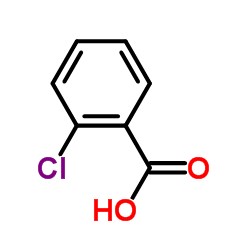 |
2-Chlorobenzoic acid
CAS:118-91-2 |
C7H5ClO2 |
|
Benzenepolycarboxylic acids with potential anti-hemorrhagic ...
2011-12-01 [Bioorg. Med. Chem. 19 , 7000-2, (2011)] |
|
Pseudomonas aeruginosa 142 uses a three-component ortho-halo...
1994-06-01 [J. Bacteriol. 176(11) , 3368-74, (1994)] |
|
Complete genome sequence of the haloaromatic acid-degrading ...
2011-02-01 [J. Bacteriol. 193(3) , 791-2, (2011)] |
|
2-Chlorobenzoic acid and 2,5-dichlorobenzoic acid metabolism...
1996-04-01 [Lett. Appl. Microbiol. 22(4) , 275-9, (1996)] |
|
Degradation of 2-chlorobenzoic and 2,5-dichlorobenzoic acids...
1993-01-01 [Folia Microbiol. (Praha) 38(5) , 376-8, (1993)] |