Is atherosclerotic disease associated with organic components of ambient fine particles?
Andrew J Keebaugh, Constantinos Sioutas, Payam Pakbin, James J Schauer, Loyda B Mendez, Michael T Kleinman
Index: Sci. Total Environ. 533 , 69-75, (2015)
Full Text: HTML
Abstract
Heart disease is a major killer in western societies; coronary artery disease and atherosclerosis are important contributors to this mortality. Atherosclerosis in mice with a deleted apoE gene (apoE-/-) is accelerated by exposure to ambient ultrafine particles (UFP) which are particles smaller than 180 nm in diameter. UFP contain organic components that are pro-oxidant and may cause or aggravate heart disease. Could removal of these organic constituents mitigate adverse cardiovascular effects? ApoE-/- mice were exposed to concentrated UFP (CAP), CAP from which organic constituents were removed by thermal denuding (deCAP) or purified air (controls) for 5 hr/day, 4 days/week for 8 weeks. Heart rate (HR), heart rate variability (HRV), biomarkers of oxidative stress and the sizes of arterial plaques were measured. Adverse effects were seen in CAP-exposed mice (increased size of arterial plaque, increased oxidative stress and decreased HRV, compared to controls). Adverse effects were not observed in deCAP-exposed mice. Removal of organic constituents from ambient particles resulted in significant reduction of toxic cardiovascular effects of air pollution exposure.Copyright © 2015. Published by Elsevier B.V.
Related Compounds
| Structure | Name/CAS No. | Molecular Formula | Articles |
|---|---|---|---|
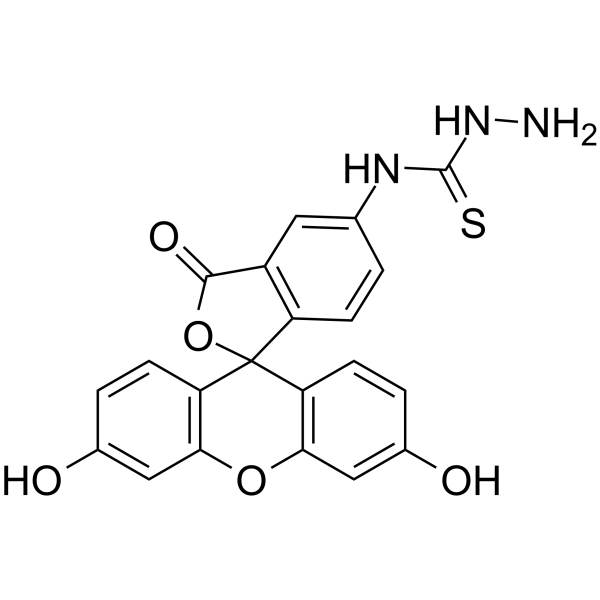 |
Fluorescein-5-thiosemicarbazide
CAS:76863-28-0 |
C21H15N3O6 |
|
Cardiovascular disease-related parameters and oxidative stre...
2014-01-01 [PLoS ONE 9(8) , e104637, (2014)] |
|
Defining NELF-E RNA binding in HIV-1 and promoter-proximal p...
2014-01-01 [PLoS Genet. 10(1) , e1004090, (2014)] |
|
Deoxygenation affects fluorescence photobleaching recovery m...
1994-01-01 [Biophys. J. 66 , 25, (1994)] |
|
Visualization of sterol-rich membrane domains with fluoresce...
2013-01-01 [PLoS ONE 8 , e83716, (2014)] |
|
Formation of circular polyribosomes on eukaryotic mRNA witho...
2014-08-01 [Nucleic Acids Res. 42(14) , 9461-9, (2014)] |