Journal of chromatography. A 2014-08-22

Calculated and experimental chromatograms for distorted gradients and non-linear solvation strength retention models.

Fabrice Gritti, Georges Guiochon

Index: J. Chromatogr. A. 1356 , 96-104, (2014)

Full Text: HTML

Abstract

Computer calculations of gradient chromatograms were performed by taking into account the adsorption behavior of the strong eluent in RPLC and the true Henry constant of the analytes. This improves the accuracy of classical gradient calculations, which all assume no affinity of the eluent modifier for the stationary phase and that the linear solvation strength model (LSSM) applies. The excess adsorption isotherm of acetonitrile with respect to water was measured by the minor disturbance method onto a Symmetry-C₁₈ RPLC adsorbent. The variations of the Henry constants of a nine compound mixture with the volume fraction of acetonitrile in the aqueous mobile phase were measured. The equilibrium dispersive model of chromatography combined with orthogonal collocation on finite elements was used to calculate chromatograms of the sample mixture for four gradient times decreasing from 25 to 1 min. The results predict a loss of resolution for the less retained analytes when the gradient times becomes smaller than 4 min. They also predict that this behavior can be eliminated when applying a quadratic gradient profile rather than a classical linear gradient. The predictions were validated by the agreement between the calculated and experimental chromatograms.Copyright © 2014 Elsevier B.V. All rights reserved.

Related Compounds

Structure Name/CAS No. Articles
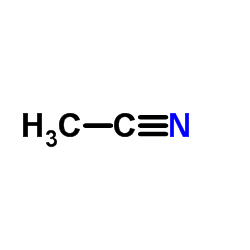
Acetonitrile Structure Acetonitrile
CAS:75-05-8
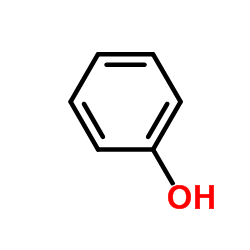
Phenol Structure Phenol
CAS:108-95-2
Water Structure Water
CAS:7732-18-5
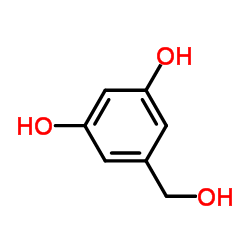
3,5-Dihydroxybenzyl alcohol Structure 3,5-Dihydroxybenzyl alcohol
CAS:29654-55-5