Purification of Semiconducting Polymer Dots by Size Exclusion Chromatography Prior to Cytotoxicity Assay and Stem Cell Labeling
Dandan Chen, Ye Yuan, Jiangbo Yu, Daniel T. Chiu, Changfeng Wu
Index: 10.1021/acs.analchem.8b00095
Full Text: HTML
Abstract
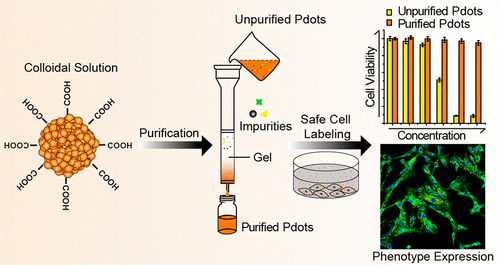
Semiconducting polymer dots (Pdots) as fluorescent probes have shown promising applications because of their excellent optical properties. However, apparent differences were observed in cytotoxicity assays, which might originate from impurities introduced in polymer synthesis or nanoparticle preparation. A simple gel-filtration-based purification method was used to address this issue. Purified Pdots displayed obviously decreased cytotoxicity as compared with the same batch of unpurified Pdots. The purified Pdots were further examined in a cytotoxicity study on mesenchymal stem cells (MSCs), which are very sensitive to exogenous probes. The results indicated that purified Pdots did not affect the proliferation ability of MSCs, while unpurified Pdots could have obvious cytotoxicity. In addition, the purified Pdots did not show cytotoxicity even after 6 months of storage. Our results demonstrated that gel filtration is an effective method for obtaining Pdots with minimal cytotoxicity, which are more suitable for biological applications.