MoS2 nanohybrid as a fluorescence sensor for highly selective detection of dopamine
Neema Pallikkarathodi Mani, Manjunatha Ganiga, Jobin Cyriac
Index: 10.1039/C7AN01770G
Full Text: HTML
Abstract
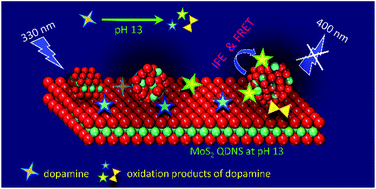
Fluorescence sensors for biologically active molecules are catching attention due to their good performance and simplicity. Herein, we report a fluorescence sensor for the selective and sensitive detection of dopamine (DA) in aqueous samples. MoS2 nanohybrid material composed of MoS2 quantum dots dispersed over MoS2 nanosheets (MoS2 QDNS) in alkaline medium was employed as the fluorescent probe. In the presence of DA, the photoluminescence intensity of MoS2 QDNS was quenched linearly with increasing concentration of the former. The quenching mechanism was found to operate via Förster resonance energy transfer (FRET), and the inner filter effect (IFE). The QDNS sensor demonstrates high selectivity towards DA, especially in the presence of ascorbic acid and uric acid, which are the most potential interference for DA in biological systems. The sensitivity of the system was as low as 0.9 nM and demonstrated two linear ranges from 2.5 nM to 5.0 μM and from 5.0 μM to 10.4 μM. The sensor demonstrated a remarkable ability in the analysis of real blood samples and showed excellent potential for visual detection.