Journal of Hazardous Materials 2018-03-26

Mechanochemical formation of chlorinated phenoxy radicals and their roles in the remediation of hexachlorobenzene contaminated soil

Shanshan Deng, Nannan Feng, Shaoguo Kang, Jianxin Zhu, Bo Yu, Jing Chen, Xiaofeng Xie

Index: 10.1016/j.jhazmat.2018.03.045

Full Text: HTML

Abstract
10.1016/j.jhazmat.2018.03.045 picture

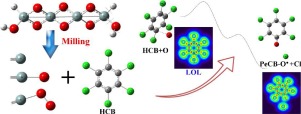
Mechanochemical degradation (MCD) is a promising eco-friendly method to dispose persistent organic pollutants (POPs). Mechanically induced free-radical attack was thought to be one of the key elements in initiating and accelerating the dechlorination and degradation of POPs. In this study, mechanochemical formation of free-radicals and their roles in the remediation of hexachlorobenzene (HCB) contaminated soil were explored using both of experimental analysis and quantum chemical calculations. It was found that chlorinated phenoxy radicals(CB-O radical dot) can be produced in the milling process and they played a vital role in the dechlorination of HCB, based on the results of electron spin-resonance (ESR) and X-ray photoelectron spectra (XPS). Two transition states of mechanochemical reaction along the formation of pentachlorinated phenoxy radical (PeCB-O radical dot) were located, with the energy barriers of 39.4 and 3.4 kJ/mol. The localized orbital locator (LOL), Mayer bond order and topological analysis were also implemented to depict the process in detail. Free-radical attack dominated dechlorination pathway of HCB in the MCD process was also verified by the Fukui function analysis. The study on the mechanically-induced generation of free-radicals and their associated modes of action on the degradation of HCB will provide a deep insight into mechanochemical remediation mechanism of POPs contaminated soil.