One-Step In Situ Synthesis of Three-Dimensional NiSb Thin Films as Anode Electrode Material for the Advanced Sodium-Ion Battery
Shihua Dong, Caixia Li, Longwei Yin
Index: 10.1002/ejic.201701362
Full Text: HTML
Abstract
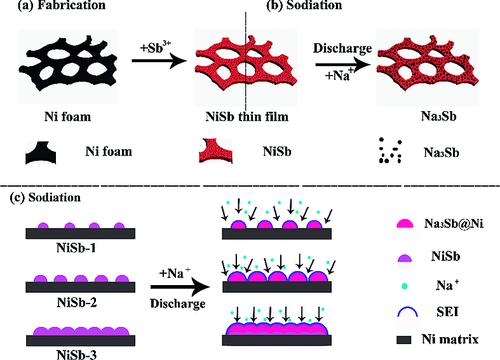
A low-cost, facile and highly efficient in situ solvothermal reaction has been developed for the first time to synthesize, by using a 3D Ni foam template, three-dimensional nickel-antimony (3D NiSb) thin films as anode electrode materials for use in sodium-ion batteries (SIBs). The structure design and preparation have proved reasonable and efficient, leading to excellent electrochemical properties. At current densities of 100, 200 and 400 mA g–1, specific capacities of 643.8, 520.5 and 378.6 mA h g–1, respectively, could be obtained. Additionally, a specific capacity of 420 mA h g–1 could be achieved after 100 cycles at a current density of 100 mA g–1. This could be attributed to the special 3D binder-free conductive network connecting the NiSb nanoparticles and the 3D contact area with the electrolyte, which is beneficial for the charge-transfer kinetics and electrochemical performance. Moreover, the porous structure offers enough space to alleviate the volume changes and stress generated in the sodiation/desodiation process. Most importantly, the 3D porous Ni foam, as a support for NiSb nanoparticles, can effectively prevent the agglomeration of the NiSb and Na3Sb nanoparticles. Therefore, such a unique NiSb anode material may be of great significance in next-generation energy storage devices. The design of NiSb on a porous 3D binder-free Ni foam conductive network is beneficial to improving the charge-transfer kinetics and alleviating the volume/stress changes occurring during sodiation/desodiation processes. Importantly, the Ni foam framework, as a support for NiSb nanoparticles, helps to enhance the electroconductivity markedly and prevents the agglomeration of Na3Sb nanoparticles.