Honeycomb polyaniline-dodecyl benzene sulfonic acid (hPANI-DBSA)/sulfur as a new cathode for high performance Li–S batteries
Mohammad Reza Sovizi, Zohre Fahimi
Index: 10.1016/j.jtice.2018.03.004
Full Text: HTML
Abstract
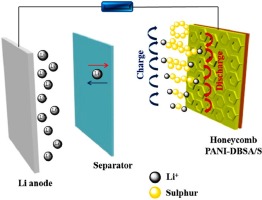
In the last few years, there has been a growing interest in lithium–sulfur (Li–S) batteries due to their high theoretical capacity of 1672 mAh/g, long life cycle, and low cost. However, Li–S batteries have been plagued with fast capacity loss and dissolution and diffusion of the polysulfides. In this study, honeycomb polyaniline-dodecyl benzene sulfonic acid (hPANI-DBSA) was prepared through the breath figure (BF) method, then, sulfur was electrodeposited on hPANI-DBSA and used to investigate the electrochemical properties of the Li–S cells. The hPANI-DBSA/S exhibit a higher capacity and excellent reversible capacity of 873.5 mAh/g after 100 cycles at 0.1 C. An initial specific capacity of 848 mAh/g at 0.2 C and coulombic efficiency of 99.3% over 100 cycles was achieved. The results suggest that this approach can also be useful for applying the Li–S cathodes for use in high capacity lithium–sulfur batteries.