The effect of NO pre-oxidizing in a temperature-swing-adsorption system for diesel NOx aftertreatment—Mechanisms to enhance its performance
Keiichiro Yoshida
Index: 10.1016/j.jtice.2018.02.029
Full Text: HTML
Abstract
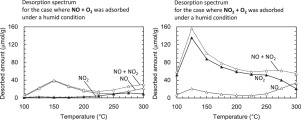
Adsorption/desorption tests and infrared (IR) absorption analysis, using simulated gas mixtures, were conducted. The adsorbent used was a Mn–Cu mixed oxide. For the adsorption/desorption test, gas mixtures composed of NO, NO2, O2, and H2O, balanced with N2, were fed to the adsorbent pellets at 100 °C in the adsorption process. In the subsequent desorption process, the temperature of the adsorbent was elevated to 300 °C, N2 was used as the carrier gas, and the desorbed gas compositions were determined. For the IR absorption analysis, the above-mentioned gas mixtures were fed to the ground Mn–Cu mixed oxide, after which the powder samples were analyzed by the attenuated total reflection method. It was found that the NO2 adsorption presented larger capacity and an increase in the formation of a surface compound that desorbs at temperatures as low as 150 °C, than the adsorption of the NO and O2 mixture. The IR absorption analysis suggested that these results could be attributed to the larger fraction of monodentate nitrates, as an adsorption state, in the case of the NO2 adsorption. Water vapor contained in the gas mixture increased the NO2 adsorption capacity by forming a surface compound similar to manganese nitrate hydrate.