Antibody-functionalized polymer nanoparticle leading to memory recovery in Alzheimer's disease-like transgenic mouse model
Dario Carradori, Claudia Balducci, Francesca Re, Davide Brambilla, Benjamin Le Droumaguet, Orfeu Flores, Alice Gaudin, Simona Mura, Gianluigi Forloni, Lara Ordoñez-Gutierrez, Francisco Wandosell, Massimo Masserini, Patrick Couvreur, Julien Nicolas, Karine Andrieux
Index: 10.1016/j.nano.2017.12.006
Full Text: HTML
Abstract
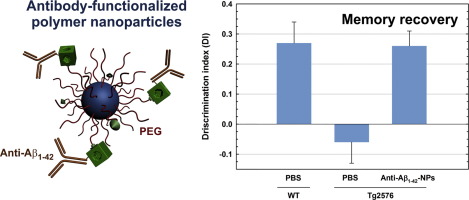
Alzheimer's disease (AD) is a neurodegenerative disorder related, in part, to the accumulation of amyloid-β peptide (Aβ) and especially the Aβ peptide 1-42 (Aβ1-42). The aim of this study was to design nanocarriers able to: (i) interact with the Aβ1-42 in the blood and promote its elimination through the “sink effect” and (ii) correct the memory defect observed in AD-like transgenic mice. To do so, biodegradable, PEGylated nanoparticles were surface-functionalized with an antibody directed against Aβ1-42. Treatment of AD-like transgenic mice with anti-Aβ1-42-functionalized nanoparticles led to: (i) complete correction of the memory defect; (ii) significant reduction of the Aβ soluble peptide and its oligomer level in the brain and (iii) significant increase of the Aβ levels in plasma. This study represents the first example of Aβ1-42 monoclonal antibody-decorated nanoparticle-based therapy against AD leading to complete correction of the memory defect in an experimental model of AD.