Entrance Effects Induced Rectified Ionic Transport in a Nanopore/Channel
Yu Ma, Jinxiu Guo, Laibing Jia, Yanbo Xie
Index: 10.1021/acssensors.7b00793
Full Text: HTML
Abstract
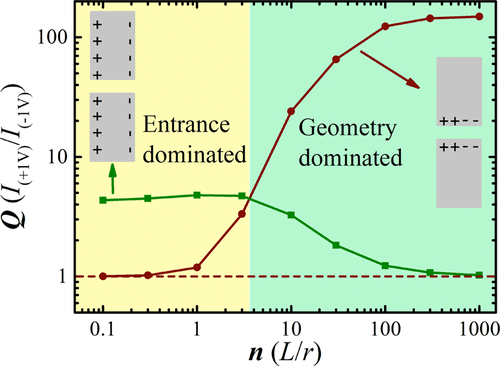
The nanofluidic diode, as one of the emerging nanofluidic logic devices, has been used in many fields such as biosensors, energy harvesting, and so on. However, the entrance effects of the nanofluidic ionic conductance were less discussed, which can be a crucial factor for the ionic conduction. Here we calculate the ionic conductance as a function of the length-to-pore ratio (L/r), which has a clear boundary between nanopore (surface dominated) and nanochannel (geometry dominated) electrically in diluted salt solution. These entrance effects are even more obvious in the rectified ionic conduction with oppositely charged exterior surfaces of a nanopore. We build three models—Exterior Charged Surface model (ECS), Inner Charged Surface model (ICS), and All Charged Surface model (ACS)—to discuss the entrance effects on the ionic conduction. Our results demonstrate, for a thin nanopore, that the ECS model has a larger ionic rectification factor (Q) than that of ICS model, with a totally reversed tendency of Q compared to the ICS and ACS models as L/r increases. Our models predict an alternative option of building nanofluidic biosensors that only need to modify the exterior surface of a nanopore, avoiding the slow diffusion of molecules in the nanochannel.