Mechanistic Insights on the Reduction of CO2 to Silylformates Catalyzed by Ir-NSiN Species
Alejandro Julián, Jefferson Guzmán, E. A. Jaseer, Francisco J. Fernández-Alvarez, Raquel Royo, Víctor Polo, Pilar García-Orduña, Fernando J. Lahoz, Luis A. Oro
Index: 10.1002/chem.201702246
Full Text: HTML
Abstract
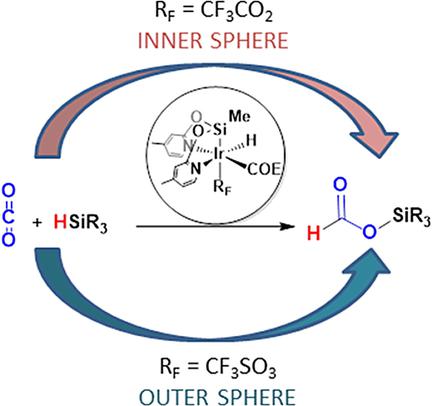
The hydrosilylation of CO2 with different silanes such as HSiEt3, HSiMe2Ph, HSiMePh2, HSiMe(OSiMe3)2, and HSi(OSiMe3)3 in the presence of catalytic ammounts of the iridium(III) complex [Ir(H)(CF3CO2)(NSiN*)(coe)] (1; NSiN*=fac-bis-(4-methylpyridine-2-yloxy); coe=cis-cyclooctene) has been comparatively studied. The activity of the hydrosilylation catalytic system based on 1 depends on the nature of the reducing agent, where HSiMe(OSiMe3)2 has proven to be the most active. The aforementioned reactions were found to be highly selective toward the formation of the corresponding silylformate. It has been found that using 1 as catalyst precursor above 328 K decreases the activity through a thermally competitive mechanistic pathway. Indeed, the reduction of the ancillary trifluoroacetate ligand to give the corresponding silylether CF3CH2OSiR3 has been observed. Moreover, mechanistic studies for the 1-catalyzed CO2-hydrosilylation reaction based on experimental and theoretical studies suggest that 1 prefers an inner-sphere mechanism for the CO2 reduction, whereas the closely related [Ir(H)(CF3SO3)(NSiN)(coe)] catalyst, bearing a triflate instead of trifluoroacetate ligand, follows an outer-sphere mechanism.