Discrepancy Between Experimental and Theoretical Predictions of the Adiabaticity of Ti++CH3OH
Brendan C. Sweeny, Shaun G. Ard, David C. McDonald, Oscar Martinez, Albert A. Viggiano, Nicholas S. Shuman
Index: 10.1002/chem.201703002
Full Text: HTML
Abstract
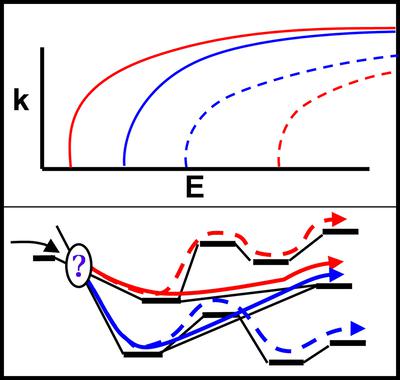
The reaction between Ti+ and methanol (CH3OH) is a model system for competition between activation of C−O, C−H, and O−H bonds and of the role of excited electronic pathways in catalytic processes. Herein, we use experimental kinetics, quantum chemical calculations, and statistical modeling to identify the critical features of the reaction's potential energy surface. Experimental kinetics data between 300 and 600 K shows the reaction largely proceeds through C−O bond activation, yielding TiOH+ and TiO+. Products of the O−H activation pathway, TiOCH2+ and TiOCH3+ are minor, whereas C−H bond activation is not observed at thermal energies. Statistical modeling well-reproduces the experimental results and offers insight into the reaction mechanism. Notably, efficient spin-crossing along the C−O activation pathway is required to produce the observed product distribution, in contrast to a previous estimate of inefficient crossing based on calculation of a small spin-orbit coupling constant. This discrepancy highlights a potential limitation of simple models within the Landau–Zener framework, which are commonly used to calculate surface-crossing probabilities in reactive systems.