Stimuli responsive phthalocyanine-based fluorescent probes and photosensitizers
Roy C.H. Wong, Pui-Chi Lo, Dennis K.P. Ng
Index: 10.1016/j.ccr.2017.10.006
Full Text: HTML
Abstract
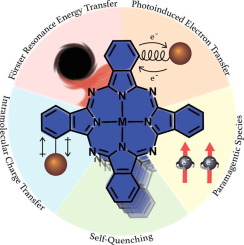
Being a versatile class of functional dyes, phthalocyanines exhibit a range of intriguing properties enabling them to find practical applications in various disciplines. In the field of biomedicine, they can serve as selective fluorescent probes for bioanalysis and bioimaging, and as efficient photosensitizers for photodynamic therapy of cancer and other non-cancerous conditions. To enhance the selectivity and efficacy, phthalocyanines have been modified by incorporating control units that can modulate their photoactivities, including fluorescence emission and generation of reactive oxygen species, through various stimuli responsive processes. The use of these stimuli can activate the response of these dyes in a specific manner, thereby improving their performance for these applications. This article aims to review the current research status of stimuli responsive phthalocyanines used as fluorescent probes and photosensitizers, including both molecular and nano systems, according to the quenching mechanisms.